
- Short answer: DeFi loans are over-collateralized. When collateral value falls so that the health factor drops below 1, any address can repay part of the debt and take the collateral at a discount, called the liquidation spread. On Aave and Compound a single call can repay at most 50% of the debt.
- A 2021 study (Qin et al., ACM IMC) of MakerDAO, Aave, Compound and dYdX counted 28,138 liquidation events and USD 807.46 million of cumulative liquidation proceeds; 73.97% of liquidations paid an above-average transaction fee, which signals competition among 2,011 liquidator addresses.
- The authors find the designs well incentivize liquidators but sell excessive amounts of discounted collateral at the borrowers’ expense, and show that a liquidator can use two successive liquidations to get around the 50% close factor.
- A 43% drop in ETH, similar to 13 March 2020, would have made USD 1.07 billion of collateral liquidatable on MakerDAO. The paper describes 2021 designs; protocol parameters have changed since.
Short answer. A DeFi loan is over-collateralized: you lock collateral worth more than you borrow. If the collateral falls in value until the loan’s health factor drops below 1, anyone can repay part of your debt and take your collateral at a discount. That open invitation, paid by a discount, is how Aave, Compound and similar protocols clean up bad loans without a bank. A 2021 study measured how it worked for two years.1
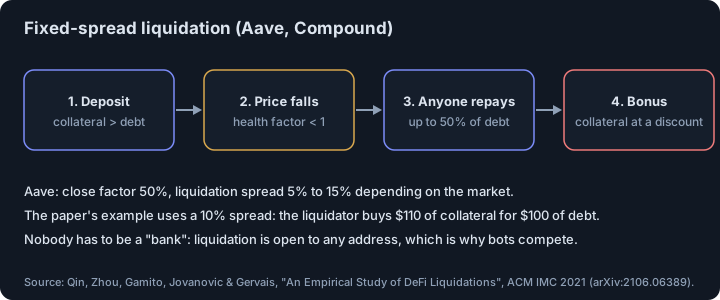
How does a DeFi liquidation work?
The paper explains the flow. Lenders deposit assets into a lending smart contract; borrowers post collateral and borrow other assets. Because there is no way to chase a defaulter, the debt is smaller than the collateral. If the collateral value falls under a threshold, for instance below 150% of the debt in one example, the debt can be recovered by liquidation, or the borrower can top up collateral or repay.1 Repaying manually is impractical for most users, as it needs constant monitoring of the blockchain, the collateral price and the transaction fee.
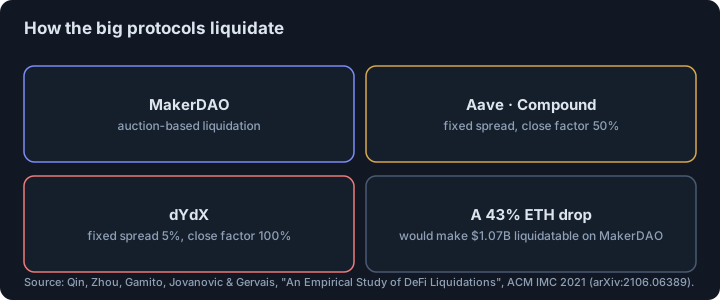
On Aave, “when the health factor drops below 1”, any liquidator can call a public function, repay the debt in part or in full (but at most 50% in one call, the close factor) and profit from the liquidation spread, which ranges from 5% to 15% depending on the market. Compound works similarly: at most 50% of the debt per liquidation, and the liquidator receives the collateral at the market price minus the spread. dYdX has a fixed 5% spread on its main markets and a 100% close factor.1 The paper’s worked example: a user deposits 3 ETH at USD 3,500 (USD 10,500) and, with a liquidation threshold of 0.8, borrows USD 8,400 of USDC. ETH falls to USD 3,300; the borrowing capacity drops to USD 7,920 and the health factor to 0.94, below 1. A liquidator repays 50% of the debt, USD 4,200, and buys the collateral at USD 3,000 per ETH (the USD 3,300 price divided by 1 + the 10% spread), receiving USD 4,620 worth of ETH.
How is MakerDAO different?
MakerDAO is not a lender of existing deposits: it issues the DAI stablecoin against locked collateral, for example at least 150% of the value in ETH. If the collateral value falls below the required ratio the position can be liquidated, through an auction rather than a fixed spread.1
What did two years of liquidations show?
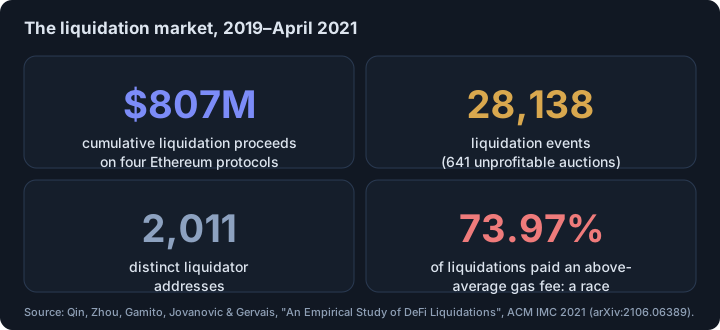
The study covers the whole life of the four protocols, which held over 85% of the Ethereum lending market at the time. It counted 28,138 liquidation events and USD 807.46 million of cumulative liquidation proceeds, with 2,011 unique liquidator addresses. Of the auction liquidations, 641 were not profitable for the liquidators. And 73.97% of liquidations paid an above-average transaction fee, which, in the authors’ words, indicates competitive behaviour.1
Who bears the cost?
The abstract states the main finding in one sentence: the existing liquidation designs “well incentivize liquidators but sell excessive amounts of discounted collateral at the borrowers’ expenses”. The reason, the authors say, is that existing DeFi systems are parameterized to allow more collateral to be liquidated than necessary. They also describe an optimal strategy that lets a liquidator lift the restriction of the close factor by performing two successive liquidations, which may aggravate the borrower’s loss.1
The paper adds a stress test. A 43% drop in ETH, similar to the fall on 13 March 2020, would make 1.07 billion USD of collateral liquidatable on MakerDAO. It also reports that even professional MakerDAO liquidation bots failed to monitor and act on price changes during blockchain congestion, and that bad debt exists: Aave V2 had accumulated up to USD 87.4 thousand by the end of April 2021.1
What a trader can take from this
- Health factor is a countdown, not a guarantee. Below 1, any bot can act on your position, and you cannot negotiate.
- The discount is your cost. With a 5% to 15% spread, liquidation costs more than a normal sale; part of your collateral is sold at a discount even if the debt is small.
- Price feeds matter. Aave prices collateral with an external oracle (Chainlink in the paper), so the liquidation trigger depends on that feed, not on the price you see on your favourite chart.
- Congestion hurts everyone. In March 2020 even professional bots failed to act. Waiting for the network to clear is not a plan.
- Centralized futures have a different ladder. The steps of an exchange liquidation, the insurance fund and auto-deleveraging are in how liquidation works on perpetual futures and auto-deleveraging in crypto; for what happens to a stablecoin when collateral value collapses, see the UST death spiral.
The paper describes the protocols as of 2021. Parameters, oracles and protocol versions have changed since; check the current documentation before relying on any number here.
This is educational material, not investment advice.
Footnotes
-
Qin, K., Zhou, L., Gamito, P., Jovanovic, P., Gervais, A., “An Empirical Study of DeFi Liquidations: Incentives, Risks, and Instabilities”, ACM IMC 2021, arXiv:2106.06389v2 (1 October 2021); full text of the PDF read. Abstract and section 1: over 85% of the Ethereum lending market, the quoted finding, over-collateralized loans, the 150% example, manual repayment impractical; contributions: 28,138 liquidation events, USD 807.46 million, 2,011 liquidators, 641 unprofitable auction liquidations, 73.97% above-average fee, Aave V2 bad debt USD 87.4 thousand, 43% ETH drop and USD 1.07 billion on MakerDAO, fixed spread favours liquidators, optimal strategy with two successive liquidations. Section 3: Aave (health factor, liquidationCall, close factor 50%, spread 5% to 15%, Chainlink), Compound (50%, market price minus spread), dYdX (5% spread, close factor 100%), MakerDAO (auction, DAI, 150%); worked example (3 ETH at USD 3,500, threshold 0.8, USD 8,400 borrowed, price falls to USD 3,300, health factor 0.94, 50% repaid, spread 10%). ↩ ↩2 ↩3 ↩4 ↩5 ↩6 ↩7
Frequently asked questions
How does liquidation work on Aave?
According to the study, when a borrower’s health factor drops below 1, any liquidator can call a public liquidation function and repay part of the outstanding debt, receiving collateral at a discount (the liquidation spread). Aave limits one call to 50% of the debt (the close factor), and the spread ranges from 5% to 15% depending on the market, as described in the paper for 2021. Aave prices collateral with the external Chainlink oracle.
What is a liquidation spread and a close factor?
The liquidation spread is the discount, or bonus, a liquidator receives on the collateral for repaying debt. The close factor is the maximum share of the debt that can be repaid in one liquidation. The paper gives Aave and Compound a 50% close factor and dYdX a 100% close factor.
How is MakerDAO liquidation different from Aave and Compound?
MakerDAO uses an auction-based liquidation, while Aave, Compound and dYdX use a fixed spread. In MakerDAO a user locks collateral (for example at least 150% of the value) to mint the DAI stablecoin, and the position can be liquidated if the collateralization falls below the required ratio.
Who profits from DeFi liquidations?
Liquidators. The study finds fixed-spread designs favour liquidators over borrowers, because the protocols are parameterized to allow more collateral to be liquidated than necessary. Across the four protocols the study counted USD 807.46 million of cumulative liquidation proceeds and 2,011 unique liquidator addresses.
Can DeFi lending create bad debt?
Yes. The paper finds borrowing positions that no longer financially motivate the borrower to repay, and reports that Aave V2 had accumulated up to USD 87.4 thousand of bad debt by the end of April 2021. It also notes that even professional liquidation bots of MakerDAO failed to act during blockchain congestion in March 2020.
Sources
- An Empirical Study of DeFi Liquidations: Incentives, Risks, and Instabilities. Kaihua Qin, Liyi Zhou, Pablo Gamito, Philipp Jovanovic, Arthur Gervais. ACM Internet Measurement Conference (IMC 2021); arXiv:2106.06389v2 (full text read), 2021
This article is research, not investment advice. Results on history do not guarantee future results.