
- Short answer: no. Buying spot and shorting a future locks in the gap between them, but the BIS paper “Crypto carry” shows the position can be liquidated before the gap closes, because margin requirements spike when price runs up.
- Across exchanges the crypto futures basis averaged about 10% a year from April 2019 to January 2022, with peaks above 40% on a crypto-native exchange and up to 60% at the maximum. That is far above the carry the authors cite for equities, bonds, currencies and commodities.
- Interest-rate differences explained only about 2% of the variation in carry; time effects explained 88%. The authors read this as a volatile “convenience yield” from small, trend-chasing traders who want leveraged upside, against scarce arbitrage capital.
- The cash-and-carry Sharpe ratio on CME one-month futures was about 0.59 before costs, and a 10% rise in carry predicted a 44% increase in sell liquidations relative to open interest over the next month.
Short answer. Buying a coin and selling a future against it looks like free money: the two prices must meet on expiry day, and the price of the coin cancels out. The Bank for International Settlements paper “Crypto carry” documents that the gap can be very large and that taking the other side is not risk-free. The danger is not that the prices fail to converge. It is that the position can be closed by margin calls before they do.
What is crypto carry and how big is it?
The BIS authors define the object plainly. Crypto carry is the difference between futures and spot prices, the “futures basis”, and it is the return on a “cash and carry” strategy: going long spot and selling the future.1 If the future trades above spot and you hold to expiry, you keep the gap.
How large is the gap? From April 2019 to January 2022 the paper finds it averaged about 10% a year across exchanges. Over the longer run the maximum values were above 40% a year and the minimum below −20%.1 On one-month BTC futures on the OKEx exchange there were three spikes (early 2019, early 2020, March 2021) at or above 40% a year before dropping sharply; on CME the highest values reached about 30% in early 2021. The abstract gives the extreme: up to 60% a year.
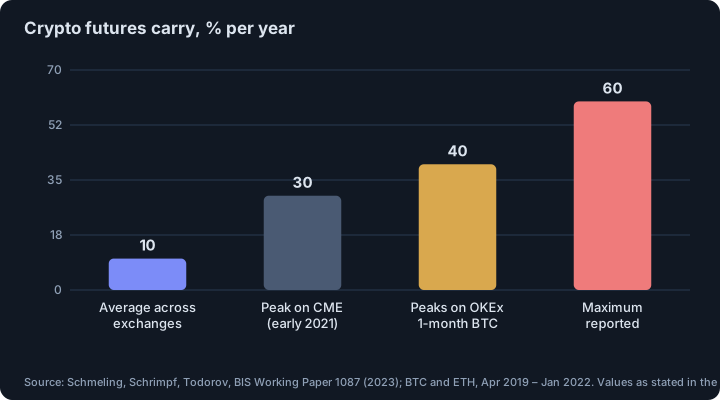
The authors add that this is larger than the carry of equities, fixed income, currencies and commodities, citing earlier work by Koijen and coauthors.1
What drives the gap if it is not interest rates?
A textbook futures price equals spot plus the interest-rate difference between the two currencies. The paper tests how much of the movement in carry that explains, and the answer is almost nothing:
| Candidate driver | Share of variation in carry |
|---|---|
| Interest-rate differentials | about 2% |
| Exchange-specific pricing errors (exchange fixed effects) | about 1% |
| Time effects common to all exchanges | 88% (BTC) |
The remainder is what the authors call a crypto convenience yield: traders are willing to pay extra for a leveraged futures position instead of owning the coin. They trace it to two forces. First, “trend-chasing and attention by smaller investors seeking leveraged upside exposure” in boom periods; carry is positively related to Reddit followers and to past returns, and on the CME, a rise in net long positions of small “nonreportable” traders goes with a rise in carry. Second, “the relative scarcity of ‘arbitrage’ capital taking the other side”.1
Carry is also very similar across crypto-native venues: correlations typically exceed 90%, so there are few exchange-specific bargains. This matches what we describe in why crypto arbitrage gaps persist: the persistent gaps are aggregate, not local.
Why is the “risk-free” trade risky?
Bloomberg’s headline in October 2021, which the paper uses as an epigraph, called it “the closest thing to a risk-free bet”.1 The authors disagree, and the reason is collateral:
such trades are risky in practice due to frictions in how collateral is handled on traditional and crypto exchanges
Schmeling, Schrimpf, Todorov, “Crypto carry”, BIS Working Paper 1087 (2023)
A round-number illustration (ours, not from the paper) shows the mechanism. Suppose $100,000 of spot BTC is held against $100,000 short in futures, with $10,000 of cash posted as futures margin:
| Price move | Spot leg | Futures leg | What the margin account sees |
|---|---|---|---|
| +10% | +$10,000 (unrealized) | −$10,000 | Margin is gone: a margin call or liquidation |
| +20% | +$20,000 (unrealized) | −$20,000 | Needs another $10,000 in cash, now |
The pair is hedged in total, but the profit is in the spot account and the loss is in the futures account. The paper lists the frictions: on CME the long spot position cannot be used as collateral for the futures position; some exchanges calculate margin in USD, so meeting a margin call means selling the spot asset, which removes the hedge and can lead to premature liquidation of the whole position; and some exchanges cap the loss on a futures position (the authors’ example: FTX in 2021, a loss limit of USD 30,000, so a 1 million USD short is liquidated after a 3% rise in BTC).2 Initial margin also differed widely: 50% on CME against less than 2% on crypto-native exchanges in the sample.1
The data agree. For one-month CME BTC futures the futures leg had a mean excess return of 3–4% a month with volatility of about 25% a month, and at 10x leverage it would have been liquidated in more than half of the months in the sample.2 A rise in carry predicts liquidations of short futures positions but not long ones, the pattern you would see if cash-and-carry shorts were being forced out: a 10% rise in carry predicts a 44% increase in sell liquidations relative to open interest over the following month.3
And the reward is modest. The annualized Sharpe ratio of the cash-and-carry strategy was about 0.6 before transaction costs and financing spreads, roughly the ballpark of the aggregate stock market, while simply holding spot BTC over the same sample had a Sharpe ratio about half as large but a higher mean return.2 Their reading: the trade is liquidity provision to leveraged trend-followers, and the capital for it is scarce and slow-moving.
Does a high basis predict anything?
Yes, and it is not comforting. In the regressions on one-month BTC futures, a rise in carry predicted a fall in both spot and futures prices, and the authors conclude that high carry “predicts future crypto price crashes”.1 Carry also predicted lower (more negative) skewness and a higher price for downside protection in options. This is a statement about the sample, not a trading rule: it is one three-year window that ended in January 2022, with a handful of boom-and-bust episodes.
What this does and does not tell a trader
- Basis is a leverage-demand gauge. A very high basis says that many people are paying up for leveraged longs. The paper links such periods to later crashes and liquidations; you can watch the same pressure in open interest and in liquidations.
- Perpetuals are different. The paper uses dated futures at constant maturities. Perpetual swaps close the gap through funding payments, so the analogue of carry there is the funding rate; the convergence-at-expiry argument does not apply in the same way.
- The risks missing from the paper. It studies margin and liquidation risk. Exchange counterparty risk, withdrawal limits and fees are further costs of the same trade; they are our addition, not a result of the paper.
- Old sample. Daily data, March 2019 to January 2022, before several exchange failures and regime changes. Do not read 10% a year as a current yield.
This is educational material, not investment advice.
Footnotes
-
Schmeling, M., Schrimpf, A., Todorov, K., “Crypto carry”, BIS Working Paper No 1087, April 2023 (full text read). Definitions and figures: Section 1 (average about 10% a year, April 2019 to January 2022, maximum above 40% and minimum below −20%; correlations across crypto-native exchanges above 90%; CME correlation 60–70%), Section 2.2 (OKEx spikes and the CME peak of about 30%; initial margin less than 2% against 50%), Section 2.3 (R² of 1% with exchange effects and 88% with time effects, BTC; interest differentials about 2%), abstract (up to 60% a year; the two forces). ↩ ↩2 ↩3 ↩4 ↩5 ↩6 ↩7
-
Same paper, Section 3.3, Table 5 and Figure 5 (cash and carry on CME one-month BTC futures, 2019–2022, collateral financed at LIBOR; the leverage-of-10 liquidation result is for the futures leg alone) and footnote 21 (FTX loss limit). The introduction gives the Sharpe ratio as about 0.59 before transaction costs; Section 3.3 says about 0.6. The authors also cite anecdotal evidence (Lyons, 2001) that arbitrageurs want Sharpe ratios of roughly 0.5–1.0 a year before committing capital, and write that crypto cash-and-carry trades “hardly pass this hurdle”. ↩ ↩2 ↩3
-
Same paper, Section 3.3 and Table 6: “a rise in carry by 10% predicts 44% increase in total sell liquidations (relative to total open interest) over the next month”. These liquidations include voluntary closing as well as forced liquidation, as the authors note. ↩
Frequently asked questions
What is cash and carry in crypto?
It is buying the coin on the spot market and selling the same amount through a futures contract. If the future trades above spot, you keep the gap as the contracts converge, and the price risk of the coin cancels out.
Is cash-and-carry arbitrage risk-free?
No. The BIS paper “Crypto carry” argues it is risky in practice because of frictions in how collateral is handled: margin can spike when price rises, and a short futures leg can be liquidated before the contract converges.
How large is the crypto futures basis?
In the BIS study it averaged about 10% a year across exchanges from April 2019 to January 2022, reached or exceeded 40% a year three times on one crypto-native exchange, and was up to 60% a year at its maximum.
Why does the futures price stay above spot instead of being arbitraged away?
The authors point to two forces: small, trend-chasing investors paying for leveraged upside, and a limited supply of capital willing to hold the opposite cash-and-carry position, which can be forced out by margin calls and liquidations.
Sources
- Crypto carry. Maik Schmeling, Andreas Schrimpf, Karamfil Todorov. BIS Working Paper No 1087, April 2023, 2023
This article is research, not investment advice. Results on history do not guarantee future results.