
- Short answer: auto-deleveraging (ADL) is the last step when a liquidated position cannot be closed without a loss that the insurance fund cannot cover. The exchange then closes profitable opposing positions, in a ranked queue, at the bankrupt trader’s price.
- On Binance the queue is ranked by profit percentage multiplied by effective leverage, so the most profitable and most leveraged positions are closed first. The position’s interface shows an indicator of the likelihood of ADL.
- A 2025–26 academic paper studied one ADL cascade on Hyperliquid, 10 October 2025: about USD 2.1 billion of positions in roughly 12 minutes, with 34,983 executions across 19,337 wallets. Its author estimates the exchange’s algorithm took USD 45.0–51.7 million more profit than needed.
- The same paper proves a trilemma: no ADL rule can satisfy exchange solvency, revenue and trader fairness together. Queue-based rules, which most centralized exchanges use, are described as “anti-fair”.
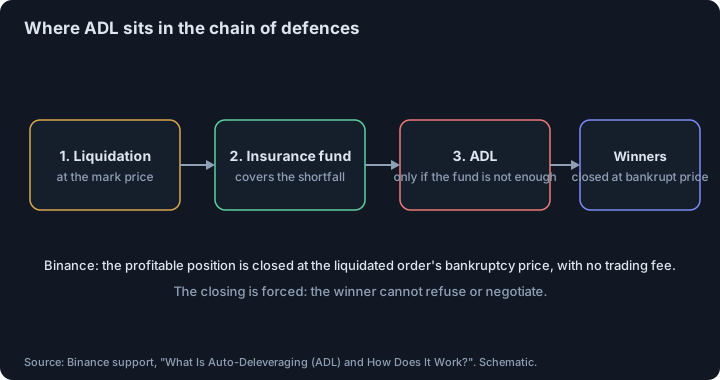
Short answer. Auto-deleveraging (ADL) is what a futures exchange does when a liquidation goes wrong and the insurance fund is not enough: it closes profitable positions on the other side of the trade, even though those traders did nothing wrong. Binance describes it as the final step of the liquidation process, used only when the insurance fund cannot absorb a bankrupt position.1 The order in which winners are chosen is written down in advance.
What is auto-deleveraging, and when does it trigger?
A leveraged position is liquidated when its margin no longer covers the maintenance requirement (we explain the trigger in how liquidation works on perpetual futures). The exchange tries to close it at or better than the bankruptcy price. If the market moves too fast and the fill is worse, a shortfall appears. The first line of defence is the insurance fund. ADL starts only after it.1
An academic paper that gave the mechanism a formal model calls it “a last-resort loss socialization mechanism for perpetual futures venues”, triggered “when solvency-preserving liquidations fail”.2 Put simply: someone has to absorb the loss, and the rule decides that profitable traders on the opposite side do.
How does Binance decide who is closed first?
Binance publishes the ranking. Profitable positions are ranked by profit and leverage, and the most profitable, most highly leveraged positions are deleveraged first.1 The formulas on its support page:
| Quantity | Formula |
|---|---|
| PNL percentage | unrealized profit / abs(position notional) |
| Effective leverage | abs(position notional) / (account balance + unrealized profit) |
| Ranking, if PNL percentage ≥ 0 | PNL percentage × effective leverage |
| Ranking, if PNL percentage < 0 | PNL percentage / effective leverage |
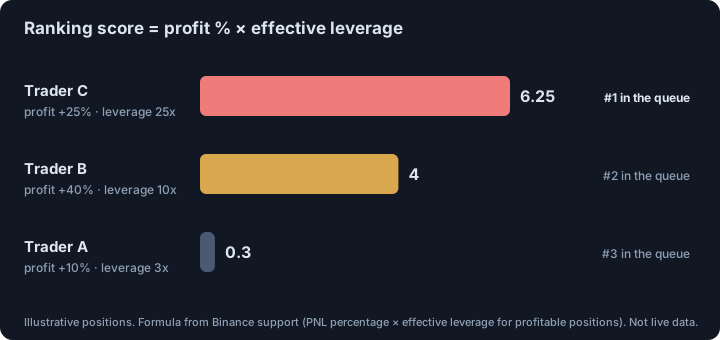
The paper traces this idea to BitMEX in 2016 (ranking by profit times leverage) and says Binance adopted the formula in 2019; it also states that the model persists on “virtually every centralized exchange”.2 Each position shows “an indicator of the likelihood that the position will be subject to ADL”, according to Binance, with a warning when it is imminent.1
At what price is a winner closed?
At the bankruptcy price of the liquidated order, not at the market price, and without a trading fee, according to Binance.1 For the winner this is a forced exit that can be at a worse level than the screen shows. It also removes the position: the profit is locked in at that price, but the exposure is gone, and a trade the trader meant to keep is over.
What happened on Hyperliquid on 10 October 2025?
The best public study of an ADL cascade is a paper by Tarun Chitra on Hyperliquid’s event of 10 October 2025. In its current version (v3, February 2026), the paper reports:2
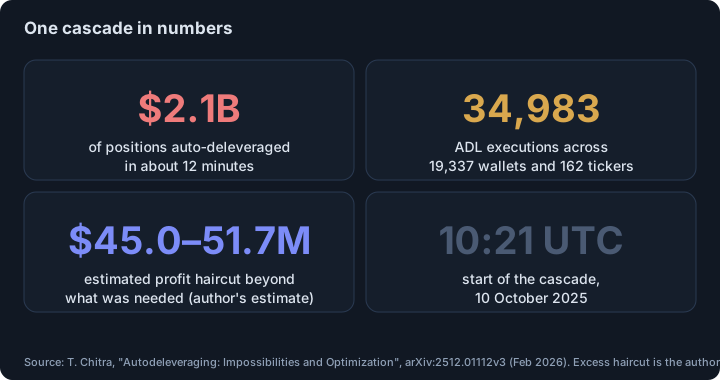
- about USD 2.1 billion of positions closed by ADL in roughly 12 minutes, in at least 40 waves starting at 10:21 UTC;
- 34,983 individual ADL executions across 19,337 distinct wallets and 162 tickers;
- an estimated USD 45.0–51.7 million of profit taken beyond the minimum needed to cover the shortfall: the author’s estimate that the production algorithm “overshot” the minimum haircut.
Two cautions. The paper has been revised (earlier versions reported different overshoot figures), so we cite only v3. And the abstract also states that Binance used ADL far more heavily than Hyperliquid, but the paper notes that Binance’s account-level ADL data is not public, so that comparison rests on a benchmark analysis, not on direct data.2
Is ADL fair?
The paper’s main theoretical result is a trilemma: no ADL policy can simultaneously satisfy exchange solvency, exchange revenue and fairness to traders, and as participation grows, moral hazard grows with it.2 It describes queue-based rules, those used by Binance and Hyperliquid, as “effectively ‘anti-fair’”, and proposes pro-rata socialization (spreading the haircut across all winners in proportion) as the rule that satisfies its fairness axioms. This is a proposal from one paper, not what exchanges do today.
What a trader can take from this
- The indicator is the signal. A position near the top of the queue is the one that will be closed first in a cascade. Reducing leverage lowers the ranking directly, because leverage is one of the two factors multiplied.
- Not only the losers pay. A profitable position is not “safe” in a cascade. The ADL risk is highest for large gains on high leverage.
- Contract type matters. Binance says coin-margined contracts are more exposed than USD-margined ones because they share smaller insurance funds.1
- Mark price is not the whole story. Liquidation is triggered by the mark price (see mark price vs last price); ADL happens after liquidation failed to clear.
Related. A cascade of forced closings also drops open interest; how to read that is in what open interest tells you. A different loss spiral, in a stablecoin: the UST death spiral.
This is educational material, not investment advice.
Footnotes
-
Binance Support, “What Is Auto-Deleveraging (ADL) and How Does It Work?” (FAQ 360033525471; page read October 2026): ADL as the final step when the insurance fund cannot absorb a bankrupt position; coin-margined contracts more exposed; ranking formulas for PNL percentage, effective leverage and the ranking; the ADL indicator; closing at the bankruptcy price of the liquidated order without a trading fee. ↩ ↩2 ↩3 ↩4 ↩5 ↩6
-
Chitra, T., “Autodeleveraging: Impossibilities and Optimization”, arXiv:2512.01112 (v1 30 November 2025, v3 16 February 2026; abstract and sections read in the HTML version). Definition of ADL (abstract, section 1); BitMEX 2016 and Binance 2019 profit-times-leverage ranking; Hyperliquid 10 October 2025 figures (abstract, section 1 and footnote 4: 34,983 executions, 19,337 wallets, 162 tickers); estimated excess haircut USD 45.0–51.7 million (abstract); trilemma and “anti-fair” description of queue-based rules; Binance account-level ADL data not public. ↩ ↩2 ↩3 ↩4 ↩5
Frequently asked questions
What is auto-deleveraging (ADL) in crypto futures?
ADL is a last-resort mechanism on a perpetual futures exchange. When a liquidated position cannot be closed at or better than its bankruptcy price and the insurance fund cannot absorb the loss, the exchange force-closes profitable opposing positions to cover it. The paper calls it a "last-resort loss socialization mechanism".
How does Binance decide whose position is auto-deleveraged?
Binance ranks profitable positions by profit percentage multiplied by effective leverage and closes the highest-ranked first. Its formulas: PNL percentage = unrealized profit / position notional; effective leverage = position notional / (account balance + unrealized profit); ranking = PNL percentage × effective leverage when PNL percentage is zero or positive.
At what price is my position closed in ADL?
According to Binance, a profitable position is closed at the bankruptcy price of the liquidated order, which can be far from the current market price, and no trading fee is charged on that closure.
Can I avoid auto-deleveraging?
You cannot opt out, but you can see an indicator on each position showing the likelihood that it will be deleveraged. Lower leverage and a smaller unrealized profit place a position lower in the queue, because the ranking multiplies the two. Binance also notes that coin-margined contracts are more exposed because their insurance funds are smaller.
What happened on Hyperliquid on 10 October 2025?
A paper by Tarun Chitra reports that Hyperliquid auto-deleveraged about USD 2.1 billion of positions in roughly 12 minutes, in at least 40 waves starting at 10:21 UTC, with 34,983 executions across 19,337 wallets and 162 tickers. The author estimates the algorithm overshot the minimum profit haircut by USD 45.0–51.7 million.
Sources
- What Is Auto-Deleveraging (ADL) and How Does It Work?. Binance Support (FAQ 360033525471), read October 2026, 2026
- Autodeleveraging: Impossibilities and Optimization. Tarun Chitra. arXiv:2512.01112 (v1 30 November 2025; v3 16 February 2026), categories cs.GT, q-fin.RM, q-fin.TR, 2026
This article is research, not investment advice. Results on history do not guarantee future results.