
- Short answer: MEV (originally “miner-extractable value”) is the profit that whoever orders transactions in a block can take from smart contracts, mainly by arbitrage and front-running. The 2019 paper “Flash Boys 2.0” named it and measured it.
- Bots compete for the first slot with “priority gas auctions”: they re-send the same transaction with a higher fee. The authors measured a lower bound of over USD 6 million of arbitrage revenue of one narrow kind, and a median bot profit of 65% of the revenue captured.
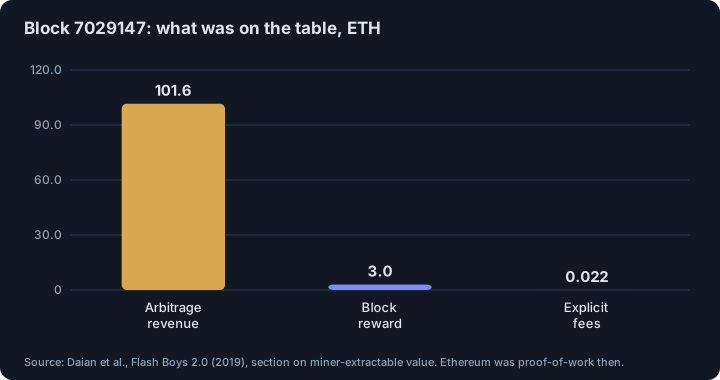
- In one Ethereum block the arbitrage was worth 101.6 ETH against a 3 ETH block reward and 0.022 ETH of explicit fees. The authors argue such sums can incentivize miners to attack the chain itself.
- The paper studies Ethereum before its move to proof of stake and measures only a conservative subset. Its numbers are a floor from 2018–2019, not today’s MEV market.
Short answer. On a blockchain, trades wait in public before they are confirmed, and whoever orders them can profit from what they see. The paper “Flash Boys 2.0” (Daian et al., 2019) coined the term miner-extractable value (MEV) for this, documented the bots that compete for it on decentralized exchanges (DEXes), and measured some of it. The original numbers are old and conservative, but they show the mechanism more clearly than most later write-ups.
Why can a bot see your trade before it executes?
A centralized exchange matches orders in the order it receives them. A DEX does not. Orders and trades are submitted as blockchain transactions that are gossiped to the whole peer-to-peer network before a miner includes them in a block; Ethereum’s block time was roughly 15 seconds at the time of writing.1 The authors put the weakness directly: on-chain trades are slow, and “adversaries can frontrun orders, observing them and placing their own orders with higher fees to ensure they are mined first”.1
Nodes can also simulate what any pending transaction will do. So when a profitable opportunity appears, for example two exchanges quoting different prices for the same token, a computable profit sits in public view.
How do bots compete for it?
Let us take the paper’s own example, a trade from November 15, 2018 on the TokenStore exchange. Someone had entered a buy order at 10 times the market rate, apparently a typo, creating a crossed order book. One transaction that traded against both sides earned:
| Item | Value |
|---|---|
| Net revenue | 0.79 ETH (about 267 USD at the time) |
| Gas price paid | 134.02 Gwei |
| Gas used | 113,265 |
| Transaction cost | 0.01518 ETH |
| Profit | about 0.77 ETH |
Because the opportunity is visible to everyone and only the first transaction to execute wins, the bots start bidding. The mechanism is neat: re-sending a transaction with the same account nonce and a higher gas price replaces the earlier bid. The authors call this a priority gas auction (PGA):
a competitive game naturally ensues among arbitrage bots to be the first to execute an atomic transaction that exploits the opportunity
Daian et al., “Flash Boys 2.0” (2019)
The miner, who is paid the gas fee, has a reason to order the highest bid first. In the observed auctions, bots raised bids by fixed fractional increments such as 12.5%, 21% or 70%, and the authors’ model, validated by their data, predicts a form of tacit cooperation with minimal gas-price increases rather than an all-out fee war.2
How big was it?
The authors restricted themselves to “pure revenue” opportunities: atomic transactions that profit in every asset they touch, which are simple to identify and measure. From such transactions they derive a lower bound of over USD 6 million of arbitrage revenue to date (since 2017, on the exchanges they could parse).1 A few more facts from the paper:
- The market was concentrated: one exchange, EtherDelta, produced most of the observed revenue, and single bots often dominated for long periods.
- Across 138,948 observed pure-revenue transactions, the median profit was 65% of the opportunity’s revenue (profit is revenue minus estimated gas cost).3
- The authors ran their own bot to check feasibility: it captured pure-revenue opportunities at a 58% success rate, and it was soon outcompeted by other bots after the authors’ early write-up was published.
Why does it matter for the chain itself?
Daian and coauthors define MEV as the total amount miners can extract from “manipulation of transactions within a given timeframe”.1 Their point is that if ordering is worth more than the block reward, honest mining stops being the best strategy. The highest block they found, block 7029147, held an arbitrage trade of 101.6 ETH, which they say dwarfed the 3 ETH block reward and 0.022 ETH of explicit fees; in the highest blocks the ordering fees exceeded the block reward and transaction fees, often by more than an order of magnitude.3
From this they derive attacks, which they call fee-based forking and “time-bandit” attacks: a miner could rewrite recent history to capture past MEV. They also give a rough comparison: DEX trading volume on Ethereum peaked at 1.5 billion USD in July 2018, while the cost of a 51% attack on Ethereum was estimated at about 56 million USD for a month.3 This is a risk argument and a warning, not an observed attack.
What has changed since the paper?
- Proof of stake. Ethereum moved from mining to proof of stake in September 2022. The paper itself notes that auction dynamics could differ on proof-of-stake chains, where block producers are known in advance and bids can be sealed, and its attacks are described for proof of work.1
- Terminology. Later literature and the industry often say “maximal extractable value”. Ordering power now sits with validators and specialized builders.
- Conservative scope. The USD 6 million is a floor for one narrow kind of arbitrage on supported exchanges. The paper says it “may be missing” opportunities from unsupported ones, and it measures arbitrage, not the broader range of strategies called MEV today.
What a trader can take from this
- Public means exploitable. A pending swap with a loose slippage tolerance can be traded against by a bot that sees it. A tight limit on acceptable price is the basic protection; the cost of a worse execution is explained in slippage and price impact.
- Gaps are not free money. The same bots are why cross-venue gaps are small and short-lived on-chain: see why crypto arbitrage gaps persist for where gaps survive. If you try to compete, you are bidding against software that pays most of the margin to miners.
- Visible is not the same as real. Orders you can see in a public book may be moved or cancelled; compare with spoofing.
This is educational material, not investment advice.
Footnotes
-
Daian, P. et al., “Flash Boys 2.0: Frontrunning, Transaction Reordering, and Consensus Instability in Decentralized Exchanges”, arXiv:1904.05234 (April 2019; full text read). Introduction and sections I–VII: lower bound over USD 6M; PGAs (section III-C); the MEV definition (section VII); block time about 15 seconds; sealed-bid discussion for proof-of-stake chains (section V). Published later at the IEEE Symposium on Security and Privacy 2020; we cite the arXiv version we read. ↩ ↩2 ↩3 ↩4 ↩5
-
Same paper, section VI and the conclusion (section IX): “blind raising” in fixed fractional increments (12.5%, 21%, 70%) and the observed convergence to profitable cooperation with minimal gas-price increases. ↩
-
Same paper, section IV (Figure 6: median profit 65% of revenue across 138,948 observed pure-revenue transactions; Figure 4 and text: the authors’ own bot, 58% success rate), section VII (block 7029147: arbitrage revenue 101.6 ETH, block reward 3 ETH, explicit fees 0.022 ETH; the 1.5 billion USD DEX volume in July 2018 and the roughly 56 million USD monthly cost of a 51% attack according to crypto51.app at the time of writing). The “pure revenue” sample is a lower bound by design. ↩ ↩2 ↩3
Frequently asked questions
What is MEV in crypto?
MEV stands for miner-extractable value, later also called maximal extractable value: the profit available to whoever controls the ordering of transactions in a block, for example by inserting, reordering or censoring them. The paper that introduced the term defines it as the total amount miners can extract by manipulating transactions in a given timeframe.
What is front-running on a decentralized exchange?
Because pending transactions are visible to the network, a bot can see a profitable trade and send its own transaction with a higher fee so it is executed first. On Ethereum this competition takes the form of priority gas auctions.
What is a priority gas auction?
It is a bidding contest in which arbitrage bots repeatedly re-issue the same transaction with a higher gas price to obtain an earlier position in a block; the miner is paid the fee and orders the highest bid first.
Is the MEV paper still current?
Its mechanisms are still the basis of the field, but its measurements come from Ethereum in 2018–2019 under proof of work and cover only a conservative subset of arbitrage. Do not treat its totals as present-day market size.
Sources
- Flash Boys 2.0: Frontrunning, Transaction Reordering, and Consensus Instability in Decentralized Exchanges. Philip Daian, Steven Goldfeder, Tyler Kell, Yunqi Li, Xueyuan Zhao, Iddo Bentov, Lorenz Breidenbach, Ari Juels. arXiv:1904.05234, April 2019 (IEEE Symposium on Security and Privacy, 2020), 2019
This article is research, not investment advice. Results on history do not guarantee future results.