
- Short answer: a rug pull is when the creator of a token adds liquidity, attracts buyers, then withdraws all the valuable assets from the pool, leaving buyers with a token that can no longer be sold. In a study of Uniswap V2 between May and December 2020, the authors flagged 10,920 scam tokens, 50.14% of all tokens in the sample.
- Speed is the signature: 86% of the scam liquidity pools were drained within one day of being funded and 37% within one hour.
- The scammers profited at least USD 16 million from 39,762 potential victims. The authors found that 93% of the scam pools had swaps made by the token or pool creators or their collusion addresses, which creates an illusion of demand.
- The study is a detection result for one DEX version in 2020, with a classifier of 96.45% precision and 96.79% recall; the authors call their count a lower bound. It is not a statement about Uniswap today.
Short answer. A rug pull is the oldest trick in a new setting: someone creates a token, funds a liquidity pool so that people can trade it, attracts buyers, and then removes everything valuable from the pool. The buyers keep a token nobody will buy. A 2021 study scanned every token on Uniswap V2 from May to December 2020 and flagged 10,920 as scams, about half of all tokens in its sample.1
What is a rug pull, step by step?
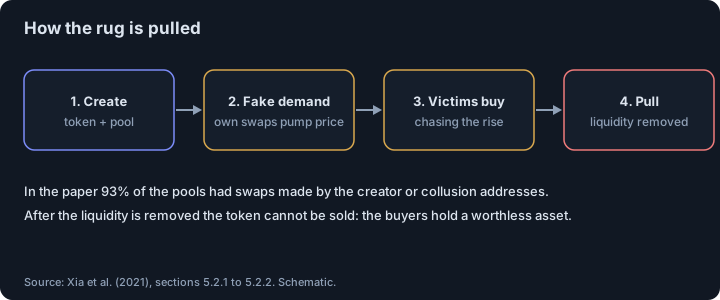
The paper defines it as a scam where developers “abandon a project and take their investors’ money”. On Uniswap, the scammer creates a token and provides liquidity by pairing it with a leading cryptocurrency such as WETH. The token is promoted through social networks, usually Telegram. When enough victims have rushed in and swapped valuable assets for the worthless token, the scammer withdraws everything from the pool and the victims are left with the token.1
The authors checked the mint and burn events of the flagged pools and found that all of them carry out rug pulls. That also explains why many Uniswap pools hold little liquidity.
How big was the problem?
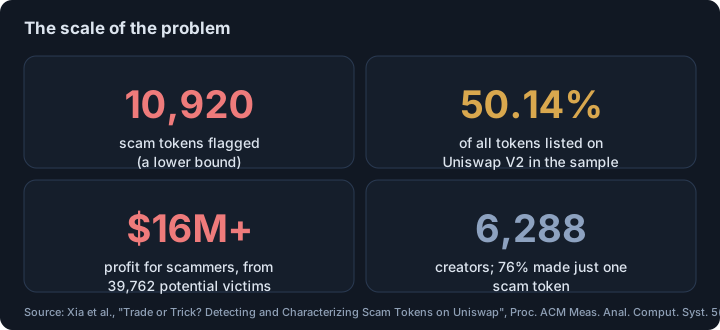
The dataset covers 21,778 tokens and 25,131 liquidity pools from 5 May to 6 December 2020. Using a guilt-by-association heuristic plus a machine-learning classifier (precision 96.45%, recall 96.79%), the authors flagged 10,920 scam tokens in 11,215 pools: 50.14% of tokens and 44.63% of pools. Their total trade volume exceeded USD 365 million, and 88,567 Ethereum addresses interacted with them. The authors call the count a lower bound.1
The scammers were not a handful: 6,288 creators made the 10,920 tokens, and 76% of them created only one. The authors identify 70,331 scam addresses, 41,118 of them collusion addresses that help the scam along, and estimate scammer profit of at least USD 16 million from 39,762 potential victim addresses, about USD 1,477 per scam pool on average.
How fast do they disappear?
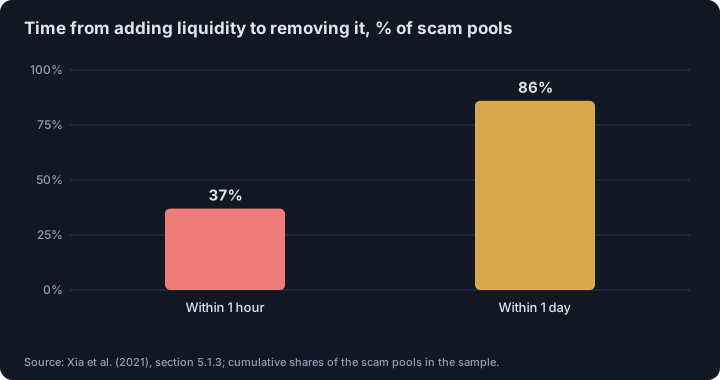
The speed is what makes a rug pull hard to react to. Measured from the first liquidity added to the first removal, over 86% of the scam pools were drained within one day and 37% within one hour.1
What tricks come with a rug pull?
The paper lists several. Most scammers fake demand: 93% of the scam pools had swaps made by the creators or their collusion addresses, and creators sometimes buy large amounts themselves to push the price up for hours. Because a swap on Uniswap raises the token’s price and volume, this builds an illusion of a popular, profitable token, and the money spent mostly returns to the attacker when it is sold or when liquidity is removed. Other tricks are baked into the contract code: the authors found 297 contracts with a free-mint function and 373 with restrictions on selling, and 63 “advance-fee” tokens that charge, for example, 5% on each transfer, supposedly for a daily bonus that is never paid.1
Impersonation pays: the ten most profitable scam tokens all imitate existing projects. The most profitable pool, a fake of a blockchain security company’s official token, made over USD 1.5 million from 365 victims.
What a trader can take from this
- Half of the tokens in the sample were scams. In a market without listing standards, the base rate matters more than the story you read in a chat.
- Volume can be fake demand. The creator’s own swaps look like interest. The same logic with Telegram signals and centralized exchanges is in how a crypto pump-and-dump works.
- You cannot sell what the pool cannot pay for. When liquidity is removed or selling is restricted in the contract, a “price” on a chart is not an exit.
- A fast chart is a warning, not a recommendation. The psychology of buying a rising price late is in FOMO in crypto trading.
- On-chain trading has other predators too. Bots that front-run trades are covered in what MEV is and how bots front-run DEX trades.
The study describes Uniswap V2 in 2020 and is a detection result; it does not tell you whether a particular token is a scam. Check the contract and the liquidity yourself, or do not trade it.
This is educational material, not investment advice.
Footnotes
-
Xia, P., Wang, H., Gao, B., Su, W., Yu, Z., Luo, X., Zhang, C., Xiao, X., Xu, G., “Trade or Trick? Detecting and Characterizing Scam Tokens on Uniswap Decentralized Exchange”, Proc. ACM Meas. Anal. Comput. Syst. 5(3), Article 39, December 2021, arXiv:2109.00229v2; full text of the PDF read. Abstract and introduction: over 10K scam tokens, roughly 50% of tokens, rug pulls, collusion addresses, at least USD 16 million from 39,762 potential victims; 70,331 scam addresses, 41,118 collusion addresses. Section 3.1.2: dataset from 5 May to 6 December 2020, 21,778 tokens, 25,131 pools. Section 5.1: 10,920 scam tokens, 11,215 pools, 50.14% and 44.63%, volume over USD 365 million, 88,567 addresses; 86% of pools drained within one day, 37% within one hour; 6,288 creators, 76% with one token. Section 5.2: definition and process of a rug pull, 93% of pools with swaps by creators or collusion addresses, 297 free-mint and 373 sale-restricted contracts, 63 advance-fee tokens (PIRATE, 5%). Profit analysis: USD 16 million, average USD 1,477 per pool, the CTK pool over USD 1.5 million from 365 victims, top-10 imitations. Classifier precision 96.45%, recall 96.79%, F1 96.62%. ↩ ↩2 ↩3 ↩4 ↩5
Frequently asked questions
What is a rug pull in crypto?
The paper defines a rug pull as a scam in which developers abandon a project and take their investors’ money. On a decentralized exchange, the scammer creates a token, adds liquidity by pairing it with a leading cryptocurrency, promotes it on social networks, and when enough victims have exchanged valuable assets for the worthless token, withdraws everything from the liquidity pool.
How common are scam tokens on Uniswap?
In the study of Uniswap V2 from 5 May to 6 December 2020, the authors identified 10,920 scam tokens with 11,215 liquidity pools, accounting for 50.14% of all tokens and 44.63% of all pools in their data, with a trade volume of over USD 365 million. They stress that this is a lower bound.
How fast do scammers remove liquidity?
Fast. Over 86% of the scam liquidity pools were drained within one day of the first liquidity being added, and 37% within one hour, which the authors read as scammers securing their money before victims can act.
How much did the scammers make?
At least USD 16 million, from 39,762 potential victim addresses, which is about USD 1,477 per scam pool on average. The most profitable pool imitated the official token of a blockchain security company and made over USD 1.5 million from 365 victims.
How can a trader spot a scam token?
The paper does not offer a checklist for traders, but its findings point to warning signs: very new tokens with a single liquidity pool, activity driven by the creator’s own addresses, tokens imitating well-known projects, and contract features such as free minting or restrictions on selling, which it found in hundreds of contracts. The authors’ own detector is a research tool, not a service.
Sources
- Trade or Trick? Detecting and Characterizing Scam Tokens on Uniswap Decentralized Exchange. Pengcheng Xia, Haoyu Wang, Bingyu Gao, Weihang Su, Zhou Yu, Xiapu Luo, Chao Zhang, Xusheng Xiao, Guoai Xu. Proceedings of the ACM on Measurement and Analysis of Computing Systems 5(3), Article 39, December 2021; arXiv:2109.00229v2 (full text read), 2021
This article is research, not investment advice. Results on history do not guarantee future results.