
- Short answer: an organizer builds a Telegram group, announces a pump time, names the coin at that moment, and members buy together. The organizer knows the coin in advance and can buy before the announcement; most members buy after it, at an inflated price.
- A 2019 study by Xu and Livshits traced 412 pumps in more than 300 Telegram channels between June 2018 and February 2019. About 100 organized channels coordinated an average of 2 pumps a day, producing about USD 6 million of artificial volume a month.
- In the case studied, the coin tripled (35 to 115 satoshi) in 15 minutes and fell below its open price 3.5 minutes after the start; the largest channel had 12,333 members, but the whole pump had only 322 trades.
- The authors estimate admins made a net profit of about 199.52 BTC (about USD 1.1 million) over 348 events, an average insider return of 18%. The study covers 2018 to 2019 on small exchanges; it does not prove the same numbers hold today.
Short answer. A pump-and-dump is a coordinated, deliberate, short-lived buying rush in a thinly traded coin. An organizer builds a group, announces a time, names the coin at that moment and asks everyone to buy at once. He knew the coin in advance, so he can already hold it. The followers buy after the announcement, near the top, and the price falls back within minutes. A 2019 study of 412 pumps organized in Telegram shows how routine the script is.1
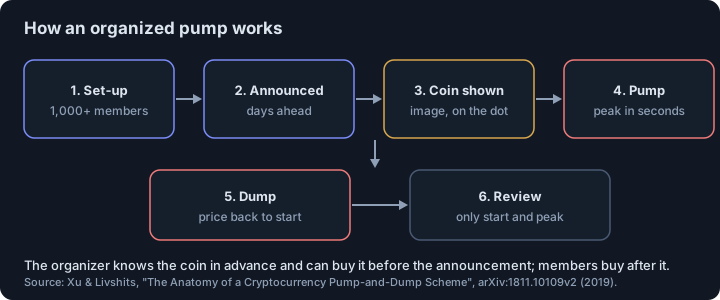
What is the script of an organized pump?
The study describes the steps. The organizer creates a public Telegram channel or group and recruits members on forums and social media. Once it has enough members, typically over 1,000, he announces the details a few days ahead: time, exchange and pairing coin. Members are told to move funds to the exchange beforehand. As the time nears, countdowns repeat the “rules”: buy fast, “shill” the coin, hold for a few minutes, sell in pieces and only at a profit.1
At the agreed moment the coin is announced, typically as an image designed to defeat text recognition. During the first minute the price surges, sometimes several-fold. A few minutes, sometimes tens of seconds, later it peaks. Participants panic-sell at the first fall, and the price bounces back to the start, sometimes lower. Within half an hour the admin posts a “review” with only two price points, the start and the peak, which gives newcomers the illusion that pumps are highly profitable.1
What did one pump look like second by second?
The authors dissect a pump on 14 November 2018 organized by at least four channels, the largest with 12,333 members. The coin, BVB, was dormant and not listed on CoinMarketCap; its last code commit was more than a year old. The first buy order was completed within one second of the first announcement, which the authors guess was automated. After a manic buying wave of about 18 seconds the price had skyrocketed to its peak, and 3.5 minutes after the start it was below its open price. Over 15 minutes the price went from 35 to 115 satoshi, three times higher.1
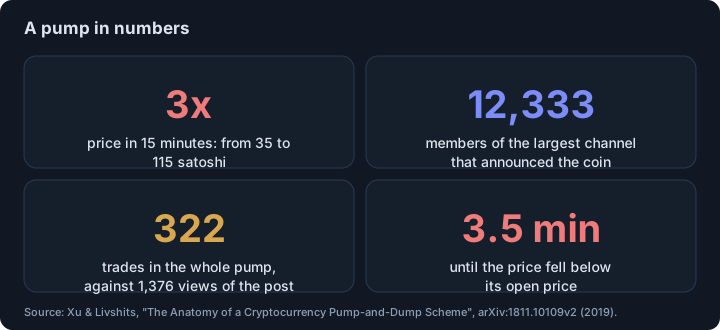
One channel announced the coin only when the price was already at its peak, which made it impossible for those who relied on that announcement to make money. The whole pump involved 322 trades, against 1,376 views of the coin announcement message and over 10,000 channel members: most members watched, or knew the difficulty of profiting.1 Across all events the study finds a negative correlation (-0.162) between the views of the announcement and the size of the gain, so audience size does not predict the pump.
Who profits, and how much?
The study counts 8,793 BTC (about USD 50 million) of trading volume during the pump hours, nine times the 943 BTC before, in only eight months. To estimate admin profit it assumes they buy just before the pump and sell into the investors’ buying: a net profit of 199.52 BTC, about USD 1.1 million, across 348 events, an average insider return of 18%. The authors note that trading is zero-sum, so aggregate investor losses should be on an equivalent scale.1
Another finding is the scale. Around 100 organized Telegram channels coordinated an average of 2 pumps a day, which generated about USD 6 million of artificial trading volume a month, which the authors call “a lot more prevalent than previously believed”. The pumps also favoured small venues.1
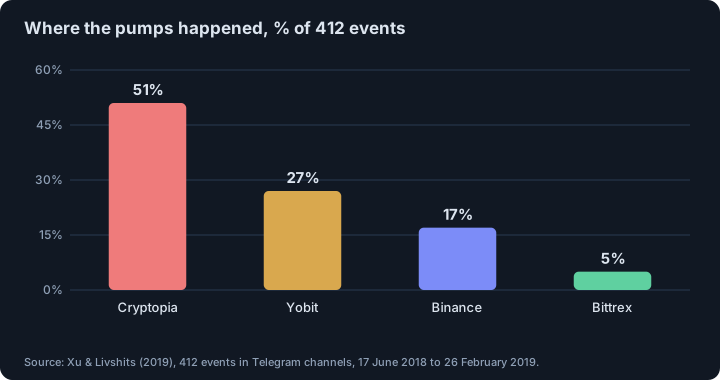
Some exchanges are not bystanders: Yobit openly organized pumps. The paper lists three benefits for an exchange: it can sell coins it bought before a pump at the pumped price, it earns high fees on the volume, and it can use its first access to order information for front-running.1
Can the pump be predicted?
The authors built a random-forest model that gives each coin on an exchange a pump likelihood before the event, with an AUC above 0.9, and described a simple strategy using it, reporting a return of 60% over eleven weeks on small retail investments under strict assumptions.1 We would not read that as a recommendation. The sample is 2018 to 2019, the model predicts which coin is chosen rather than whether you can exit at a profit, and markets have changed since.
What a trader can take from this
- A “signal” sent to thousands is not a signal. If you receive the coin name at the same time as thousands of others, the organizer is positioned before you.
- Speed is not a plan. In the case studied, an automated buy in the first second caught the move; manual buyers arrived near the peak.
- The review shows two prices. Start and peak hide every loss in between.
- Thin coins are the favourite. Dormant coins on small exchanges, with weak projects behind them, were chosen. The same psychology of chasing a rise is in FOMO in crypto trading.
- Fake volume is part of the toolkit. The study counts large artificial volume. Other forms of it are covered in wash trading in crypto: what the research found, and large resting orders that can vanish in what spoofing is in crypto.
The study covers 2018 to 2019. It is not legal advice, and it makes no claim about any particular channel today.
This is educational material, not investment advice.
Footnotes
-
Xu, J., Livshits, B., “The Anatomy of a Cryptocurrency Pump-and-Dump Scheme”, arXiv:1811.10109v2 (17 August 2019); full text of the PDF read. Abstract and introduction: 412 events in more than 300 Telegram channels, 17 June 2018 to 26 February 2019; about 100 channels, 2 pumps a day, USD 6 million a month; AUC above 0.9, 60% over eleven weeks. Section 2: actors, the typical process (set-up above 1,000 members, announcements days ahead, rules, OCR-proof image, pump, dump, review), the three benefits to exchanges, Yobit. Section 3: the BVB case of 14 November 2018 (four channels, 12,333 members, 35 to 115 satoshi in 15 minutes, first buy within one second, about 18 seconds to the peak, below open after 3.5 minutes, 322 trades, 1,376 views). Section 4: exchange shares (Cryptopia 211, Yobit 112, Binance 68, Bittrex 21 of 412), 8,793 BTC against 943 BTC, admin profit 199.52 BTC over 348 events, 18% average insider return, correlation -0.162 between views and gain, 35% of coins previously pumped on the same exchange. ↩ ↩2 ↩3 ↩4 ↩5 ↩6 ↩7 ↩8 ↩9
Frequently asked questions
How does a crypto pump-and-dump work?
According to the Xu and Livshits study, an organizer recruits members to a Telegram channel (typically over 1,000), announces a pump days ahead, sends countdowns, then names the target coin at the agreed time, usually in an image that machines cannot read. Members buy at once, the price surges in the first minute, peaks within seconds to minutes and then falls back, often to the start price or lower.
Who makes money in a pump-and-dump?
The organizers. The study estimates admins made a net profit of 199.52 BTC, about USD 1.1 million, across 348 pump events, an average insider return of 18%, assuming they bought just before the pump and sold into it. Since trading is zero-sum, the authors say aggregate investor losses are on a similar scale.
Can a normal participant profit by joining a pump?
The study says many participants end up buying at an already inflated price and become the victims. In the case it analysed, the first buy was completed within one second of the announcement, probably by automation, and the price peaked after about 18 seconds of buying; one channel announced the coin only when the price was already at its peak.
Which exchanges are used for pumps?
Of the 412 pumps in the study, 51% happened on Cryptopia, 27% on Yobit, 17% on Binance and 5% on Bittrex. Some exchanges were themselves involved: Yobit openly organized pumps. These shares describe June 2018 to February 2019.
What coins do organizers choose?
The paper says organizers prefer coins tied to unserious projects. The case coin was dormant, not listed on CoinMarketCap, with a last code commit more than a year earlier and a rating of 1 out of 5 on the exchange. In 35% of cases the coin had already been pumped on the same exchange.
Sources
- The Anatomy of a Cryptocurrency Pump-and-Dump Scheme. Jiahua Xu, Benjamin Livshits. arXiv:1811.10109v2 [q-fin.TR], 17 August 2019 (full text read), 2019
This article is research, not investment advice. Results on history do not guarantee future results.