
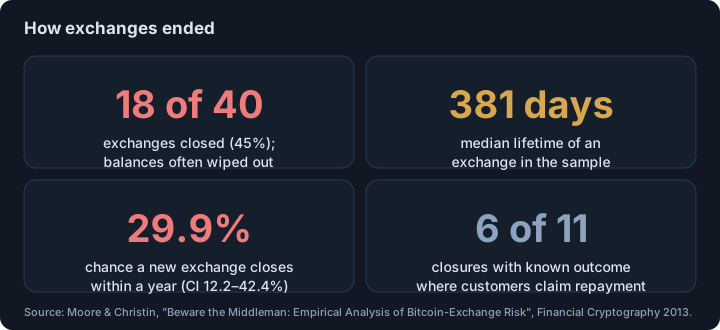
- Short answer: in the first empirical study of the question, 18 of 40 Bitcoin exchanges (45%) that had operated between about 2010 and January 2013 had closed, often with customer balances wiped out. The estimated chance that a new exchange closes within a year of opening was 29.9%, and the median lifetime was 381 days.
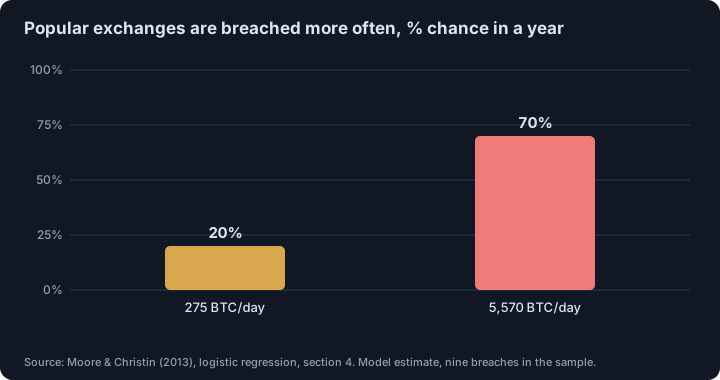
- Larger exchanges were less likely to close: doubling daily trading volume reduced the hazard of closure by about 16%. But a separate model predicted that larger exchanges were more likely to be breached: 20% for an exchange trading 275 BTC a day, 70% for one trading 5,570 BTC a day.
- Most closures did not follow an announced hack: 13 of the 18 closed without a publicly announced breach, and four of the nine breached exchanges were still operating. Of 11 closures with known outcome, customers were reimbursed in 6 cases by the operators’ or customers’ claim, and not in 5.
- The data are from 2010 to 2013 and the sample is small. The study measures the risk that existed then; it does not rate any present exchange.
Short answer. Before trusting an exchange with your coins, it helps to know how often exchanges disappear. The first empirical study of Bitcoin exchanges looked at 40 that had opened over about three years to January 2013, and found that 18 had closed, “with customer account balances often wiped out”. Fraud was sometimes to blame, but not always. The study also found a puzzle: popular exchanges were less likely to close, and more likely to be hacked.1
How many exchanges failed?
The authors collected daily trading volumes and weighted prices for 40 Bitcoin exchanges converting into 33 currencies, until 16 January 2013. An exchange counted as closed if it had made no trade for at least two weeks, which they confirmed against reports on the Bitcoin Wiki and forums. The result: 18 closures, a failure rate of 45%, and a median lifetime of 381 days.1
Simple percentages mislead, because exchanges opened at different times and most were still alive at the end of the data. So the authors used survival analysis. In their model, the probability that an average exchange survives a year is 71.1%: a 29.9% chance that a new exchange closes within a year of opening, with a 95% confidence interval from 12.2% to 42.4%.1
Were the closures caused by hacks?
Not mostly. Nine exchanges publicly reported a security breach, and five of those later closed; four survived, Mt. Gox, btc-e.com, Bitfloor and Vircurex among them. Another 13 closed without any publicly announced breach.1
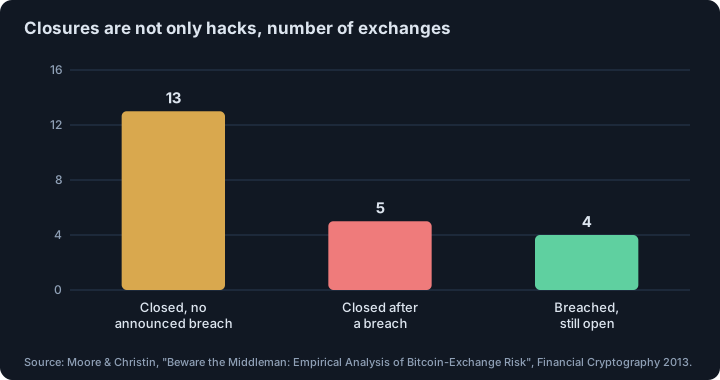
The authors note that in some cases fraudsters are to blame and in others not, and that the link between a breach and closure was positive but fell just short of statistical significance (p = 0.13). They also found that an index of anti-money-laundering compliance of the exchange’s country had no measurable correlation with closure.
Did customers get their money back?
Evidence on reimbursement exists for 11 of the 18 closed exchanges. Five did not reimburse affected customers, and six claim to have done so, based on claims by operators and investors. The authors conclude that “the risk of losing funds stored at exchanges is real but uncertain”.1
Why were popular exchanges both safer and riskier?
In the survival model, trading volume was the one factor with a clear link to closure: doubling the daily volume corresponded to a 16% reduction in the hazard of closing. Less popular exchanges were more likely to be shut than popular ones.1
A separate logistic regression went the other way. Exchanges handling 275 BTC of transactions a day had a 20% chance of being breached in a year, against 70% for exchanges processing 5,570 BTC a day. That regression rests on only nine breaches and should be read as a model estimate, but the authors state the conundrum plainly: you can choose less popular exchanges to reduce the chance of a breach, or popular ones that may be breached but are less likely to shut down without warning.
What happened to the biggest one?
At the time of the paper’s data, Mt. Gox, the largest exchange by volume (average daily transactions above 40,000 BTC), was among the exchanges still operating, and the model rated it less likely to close than average. A later paper notes that before filing for bankruptcy protection in February 2014, Mt. Gox was the world’s leading Bitcoin exchange.2 The point is not hindsight about one name: a 2013 model built on volume could not see the risk that sank the largest venue, which is why we treat any such rating as a base rate, not a guarantee.
What a trader can take from this
- Counterparty risk is a position size. Coins on an exchange are an unsecured claim on the exchange. The simplest control is to hold on an exchange only what you need to trade.
- Size is not safety. Volume reduced the chance of closing but, in the model, raised the chance of a breach. How wash trading inflates the volume that people use as a proxy for size is in fake volume on crypto exchanges.
- Failure does not need a hack. Most closures in the sample had no public breach.
- Stablecoins carry the same kind of risk. A claim on a promise, not on a reserve you can inspect, is covered in the UST death spiral and Tether and Bitcoin prices.
- Do not transfer the numbers. The sample is early Bitcoin exchanges from 2010 to 2013; it says nothing about the exchange you use today.
This is educational material, not investment advice.
Footnotes
-
Moore, T., Christin, N., “Beware the Middleman: Empirical Analysis of Bitcoin-Exchange Risk”, Financial Cryptography and Data Security 2013 (LNCS 7859, pp. 25–33), author pre-publication version; full text of the PDF read. Abstract: 40 exchanges, 18 closed, balances often wiped out, volume and closure, breaches. Section 1: market capitalisation about USD 187 million in January 2013; the quoted sentence on intermediaries. Section 2: data to 16 January 2013, closure definition (no trade for two weeks), nine breaches, five later closed, four survived (Mt. Gox, btc-e.com, Bitfloor, Vircurex), 13 closed without announced breach; reimbursement evidence for 11 of 18 (5 not reimbursed, 6 claimed); failure rate 45%, median lifetime 381 days; median daily volume 290 BTC, Mt. Gox above 40,000 BTC. Section 3: Cox model, coefficient -0.173, hazard 0.84 per doubling, breach p = 0.1338, AML indicator no correlation, S(365) = 0.711, 29.9% (12.2% to 42.4%). Section 4: logistic regression, 20% at 275 BTC a day, 70% at 5,570 BTC a day. ↩ ↩2 ↩3 ↩4 ↩5 ↩6
-
Chen, W., Wu, J., Zheng, Z., Chen, C., Zhou, Y., “Market Manipulation of Bitcoin: Evidence from Mining the Mt. Gox Transaction Network”, arXiv:1902.01941 (19 January 2019), introduction: Mt. Gox before filing for bankruptcy protection in February 2014 was the largest bitcoin intermediary and the world’s leading Bitcoin exchange. ↩
Frequently asked questions
How often did early Bitcoin exchanges fail?
In the Moore and Christin study of 40 Bitcoin exchanges with data to 16 January 2013, 18 had closed, a failure rate of 45%, and customer balances were often wiped out. The median lifetime of an exchange was 381 days. The authors estimate a 29.9% chance (12.2% to 42.4% with 95% confidence) that a new exchange closes within a year of opening.
Are bigger crypto exchanges safer?
The study gives a mixed answer. Exchanges with higher daily volume were less likely to close: doubling the volume cut the hazard of closure by about 16%. But a separate model estimated that larger exchanges were more likely to suffer a security breach, so a popular exchange could be breached yet survive, while a small one could vanish without warning.
Did customers get their money back when an exchange closed?
Often not, or it is unclear. Among the 18 closures the authors found evidence on reimbursement for 11: five exchanges did not reimburse affected customers, and six claimed to have done so. The study concludes that the risk of losing funds stored on exchanges is real but uncertain.
Is hacking the main reason exchanges close?
Not in this sample. Nine exchanges publicly reported a breach, and five of them later closed, but 13 other exchanges closed without a publicly announced breach. The authors note that fraudsters are sometimes to blame, but not always. The link between a breach and closure fell just short of statistical significance.
Does this study tell me whether a current exchange is safe?
No. It covers 40 Bitcoin exchanges from 2010 to January 2013, when Bitcoin’s market capitalisation was about USD 187 million. Regulation, custody practices and the exchanges themselves have changed. Its use is the method and the finding that failure is common, not a rating of any venue.
Sources
- Beware the Middleman: Empirical Analysis of Bitcoin-Exchange Risk. Tyler Moore, Nicolas Christin. Financial Cryptography and Data Security 2013, Springer LNCS 7859, pp. 25–33; author pre-publication version (full text read), 2013
- Market Manipulation of Bitcoin: Evidence from Mining the Mt. Gox Transaction Network. Weili Chen, Jun Wu, Zibin Zheng, Chuan Chen, Yuren Zhou. arXiv:1902.01941 (January 2019); used only for the date of the Mt. Gox bankruptcy filing, 2019
This article is research, not investment advice. Results on history do not guarantee future results.