
- Short answer: on Binance Futures liquidation is triggered when the mark price reaches your liquidation price, not the last traded price. The two can differ, so a position can be liquidated while the chart of the last price has not touched the level, and a wick of the last price can pass through it without liquidating anyone.
- Binance’s stated formula is Mark Price = Median (Price 1, Price 2, Contract Price). Price 1 uses the index price and the last funding rate, Price 2 uses the index plus a 30-second moving average of the futures premium.
- Because it is a median, a single spike in the contract price is cut off: it is outvoted by the two index-based prices. That is the point of the design, which Binance describes as preventing unnecessary liquidations and discouraging manipulation.
- Always check which price your chart and alert show. A chart of the last price is the wrong instrument for judging how close you are to liquidation.
Short answer. Binance liquidates a futures position when the mark price reaches the position’s liquidation price. The mark price is not the price on your chart. It is a separate number built from the index price, funding and the contract’s own price, and it can sit above or below the last traded price for minutes at a time. That is why a trader can be liquidated without the candle touching the level, and why a violent wick can pass through a liquidation level without liquidating anyone.
What price actually triggers a liquidation?
Binance is explicit in its Futures FAQ: “Liquidation occurs when the Mark Price hits the liquidation price of a position.”1 The same FAQ explains why the two prices exist and what each is used for: liquidation prices and unrealized PnL are calculated from the mark price, while the last price is what realized PnL is based on.12
It also gives the trigger as a margin condition: collateral, equal to initial collateral plus realized and unrealized PnL, falling below the maintenance margin.1 The unrealized PnL in that expression is computed at the mark price. We wrote up the whole procedure, including the margin ratio and the insurance fund, in futures liquidation explained.
How is the mark price built?
For perpetual contracts Binance publishes a formula:2
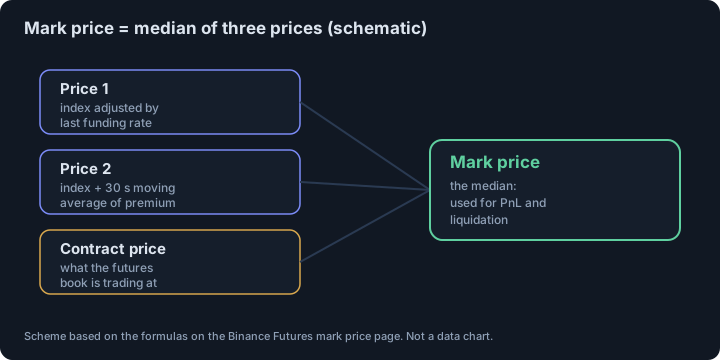
- Mark Price = Median (Price 1, Price 2, Contract Price).
- Price 1 = Price Index × (1 + Last Funding Rate × (Time Until Next Funding / Funding Period)).
- Price 2 = Price Index + Moving Average (30 seconds basis). The moving average is of the contract’s mid price (average of best bid and ask) minus the price index, sampled once per second. Binance states that TradFi perpetual contracts use a 60-second average.
The median of three numbers is the middle one. So if one input is an outlier, it is simply not chosen. A momentary wick of the contract price, which is only one of the three inputs, cannot drag the mark price by itself. Binance gives the intent as to “prevent unnecessary liquidations and discourage market manipulations by bad actors.”2
A worked example (our illustration, invented numbers)
Assume an index price of 100,000, a last funding rate of +0.01% per period with half of an 8-hour period left, and a futures contract trading with a small premium to the index. Here are two moments:
| Spike on a thin book | Contract rich, index falling | |
|---|---|---|
| Index price | 100,000 | 99,200 |
| Price 1 (index × funding adjustment) | 100,005 | ≈ 99,205 |
| Price 2 (index + 30 s average premium) | 100,060 (+60) | 99,280 (+80) |
| Contract price (last traded) | 100,700 | 99,400 |
| Mark price (median) | 100,060 | 99,280 |
| Short with liquidation price 100,500 | Last price crossed it, mark did not: not liquidated | n/a |
| Long with liquidation price 99,300 | n/a | Last price is still above it, mark is below: liquidated |
In the first column the last price spiked 700 above the index, but the mark moved only 60. A short with a liquidation level at 100,500 saw the chart pass through it and survived. In the second column the contract still trades at 99,400, above the long’s level of 99,300, so the chart looks safe, but the mark price is 99,280 and the position is gone. Neither outcome needs any exchange error: both follow from the formula.
Why does this matter for your risk management?
- Alert on the mark price. Alerts, stop orders and lines that reference the last price measure a different thing from the trigger. Check which price type your terminal uses for each, and whether it lets you choose the mark price.
- The liquidation price is a moving number. Because the trigger includes realized and unrealized PnL, a change in other positions or accrued costs can shift the level (our reading of the formula; confirm in your own account’s liquidation price field).
- Funding matters twice. Funding enters Price 1 through the last funding rate, and it also drains or adds to collateral over time (how funding works).
- Binance describes a fallback. The mark price page says that in some conditions a protective fallback temporarily changes the index reference. Rules like this are the reason to read the current version of the page for the contract you trade.
- Watch the market, not only your own chart. Our liquidations board shows forced orders as they print on Binance, which is the other side of the same mechanism.
Related. The step after a failed liquidation is explained in auto-deleveraging (ADL) in crypto futures.
This is educational material, not investment advice. The formulas are as published by Binance when we read the pages; exchanges revise them, and contracts differ, so check the page for your instrument.
Footnotes
-
Binance Support, “Binance Futures Liquidation Protocols”. Sections “How to calculate the liquidation price?” and “What is the difference between Mark Price and Last Price?”. Page read through a fetch tool that returns the text of the page; formulas and sentences quoted as presented there. ↩ ↩2 ↩3
-
Binance Support, “Introduction to Binance Futures Mark Price”. Formulas for perpetual contracts, the 30-second basis (60 seconds for TradFi perpetual contracts) and the stated purpose of the mark price. The page also describes a protective fallback for the price index; we do not describe its mechanics here. ↩ ↩2 ↩3
Frequently asked questions
Does Binance liquidate on mark price or last price?
On mark price. Binance’s liquidation FAQ states that liquidation occurs when the mark price hits the liquidation price of a position. The last price is used for realized PnL.
Why was I liquidated when the price never reached my liquidation price?
Usually because you were watching the last price chart while the mark price, a different number, reached your level. The mark price can sit below the last price when the futures contract trades at a premium to the index.
How is the Binance mark price calculated?
For perpetual contracts it is the median of three prices: Price 1 (index price adjusted by the last funding rate and time to the next funding), Price 2 (index price plus a 30-second moving average of the contract’s premium to the index) and the contract price.
Why does Binance use a mark price at all?
Binance says it uses the mark price to prevent unnecessary liquidations and discourage market manipulation. A single large order on a thin book can move the last price briefly without changing what the contract is really worth.
Sources
- Introduction to Binance Futures Mark Price. Binance Support (Futures FAQ), 2026
- Binance Futures Liquidation Protocols. Binance Support (Futures FAQ), 2026
This article is research, not investment advice. Results on history do not guarantee future results.