
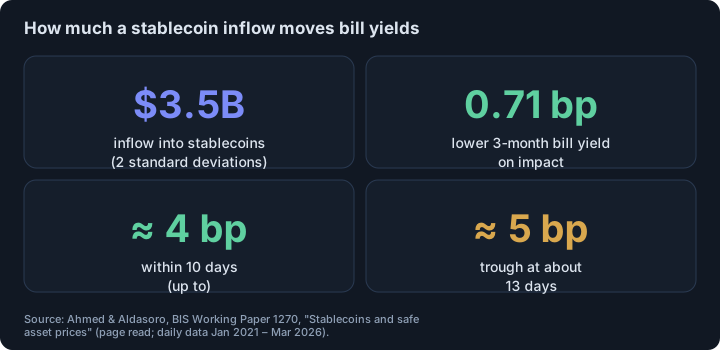
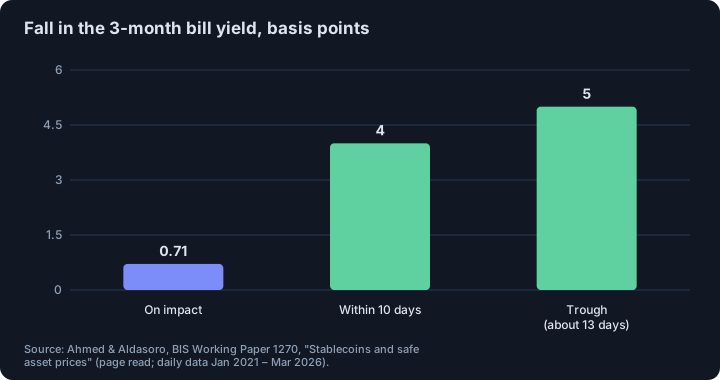
- Short answer: yes, slightly. In BIS Working Paper 1270 (Ahmed and Aldasoro) a 3.5 billion dollar inflow into dollar stablecoins (2 standard deviations) lowers 3-month Treasury bill yields by 0.71 basis points on impact and up to 4 basis points within 10 days, with a trough of roughly 5 basis points at 13 days.
- The effect sits at the short end: no meaningful spillover to longer maturities. It is larger when Treasury-market intermediaries are under stress and has grown with the scale of the stablecoin sector.
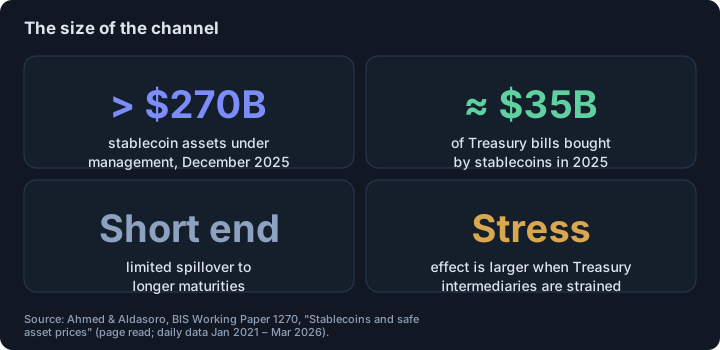
- Scale: combined stablecoin assets exceeded 270 billion dollars in December 2025, more than the short-term US securities held by major foreign investors, and stablecoins bought nearly 35 billion dollars of bills in 2025.
- What the paper does not say: it does not study whether stablecoin flows move Bitcoin or any crypto price. One basis point is a hundredth of a percentage point, so the effects are measured in hundredths of a percentage point.
Short answer. Stablecoins have become large enough to move a market that has nothing to do with crypto. A BIS working paper estimates that when 3.5 billion dollars flow into dollar stablecoins, the yield on 3-month US Treasury bills falls by 0.71 basis points at once, about 4 within 10 days and roughly 5 at the trough after 13 days.1 The effect is small, but it runs through a channel that links crypto to the safe-asset market.
Why would stablecoins affect bill yields?
Most stablecoins are pegged to the dollar, and the assets that back them are mostly short-term dollar instruments such as Treasury bills.1 The logic is straightforward: when people buy stablecoins, issuers buy more reserve assets, so demand for short-term Treasuries rises and their yields fall; when people redeem, the opposite. The BIS page puts the scale in context: combined assets of stablecoins exceeded 270 billion dollars in December 2025, more than the short-term US securities held by major foreign investors, and in 2025 they bought nearly 35 billion dollars of bills, similar to the largest US government money market funds and more than most foreign purchases.1
What exactly did the paper do?
The authors, Rashad Ahmed and Iñaki Aldasoro of the BIS, use daily data from January 2021 to March 2026. To separate the effect of stablecoin flows from other things that move bill yields, they use local projections and a granular instrumental variable that exploits idiosyncratic variation in stablecoin growth at the level of token-blockchain pairs.1 In plain terms (our gloss): instead of looking at total growth, which could be driven by the same news that moves yields, they look at growth specific to individual tokens on individual blockchains.
This is based on the paper’s abstract and the BIS summary page; we could not retrieve the full PDF, so the details of the instrument and the robustness checks are not reported here.
How large is the effect?
For a 2-standard-deviation inflow, which the authors translate into 3.5 billion dollars, the 3-month bill yield falls 0.71 basis points on impact and up to 4 basis points within 10 days; the BIS summary adds a trough of roughly 5 basis points at 13 days.1
A basis point is a hundredth of a percentage point, so 4 basis points is 0.04 points, for instance a move from 4.00% to 3.96%. The authors present it as evidence that stablecoins have “already established themselves as significant players in Treasury markets”, not as evidence that they set the yield.1
Where is it larger?
The effect is concentrated at the short end, with no spillovers to longer maturities, according to the summary.1 It is not constant: the channel is stronger when Treasury-market intermediaries are under stress, and it has strengthened as the stablecoin sector has matured and grown.1
What are the implications?
The authors point to three: for monetary policy, because a new group of buyers affects short-term rates; for the transparency of stablecoin reserves, because what the reserves hold matters to the bill market; and for financial stability, particularly in stress, when the channel is stronger.1 The same logic suggests why the quality of reserves matters when a stablecoin loses its peg; for a case study, see the collapse of Terra and Tether and Bitcoin prices.
What does it not tell a crypto trader?
- It says nothing about whether stablecoin inflows lift Bitcoin or altcoin prices. We are not aware of a test of that in the sources we read, and the paper does not make that claim.
- It measures a daily effect on a government bill yield; for the cost of trading crypto you want slippage and price impact from your own fills.
- The numbers are the authors’ estimates for 2021–2026 and they depend on the instrument; they are not a forecast.
This is educational material, not investment advice.
Related. Tether and Bitcoin prices, the collapse of Terra.
Footnotes
-
Rashad Ahmed and Iñaki Aldasoro, “Stablecoins and safe asset prices”, BIS Working Paper 1270, published 28 May 2025 (the BIS page lists data to March 2026 and figures as of December 2025, so it appears to carry a later revision; the page records no version history). We read the BIS publication page: abstract, “Focus”, “Contribution” and “Findings”; the full 54-page PDF could not be retrieved. Numbers are quoted from that page; “limited spillovers” is the abstract’s wording and “no spillovers” the findings’ wording. ↩ ↩2 ↩3 ↩4 ↩5 ↩6 ↩7 ↩8 ↩9
Frequently asked questions
Do stablecoins affect US Treasury bill yields?
According to BIS Working Paper 1270, yes: a 3.5 billion dollar inflow into dollar-backed stablecoins lowers 3-month Treasury bill yields by 0.71 basis points on impact and up to 4 basis points within 10 days, with limited spillover to longer maturities.
How many Treasury bills do stablecoins hold?
The BIS page says that combined stablecoin assets under management exceeded 270 billion dollars in December 2025 and that stablecoins bought nearly 35 billion dollars of Treasury bills in 2025, similar to the largest US government money market funds.
What is a basis point?
A basis point is one hundredth of a percentage point. A move of 4 basis points in a bill yield is 0.04 percentage points, for example from 4.00% to 3.96%.
Does this mean stablecoin inflows move Bitcoin’s price?
No. The paper studies the effect on Treasury bill yields only. Whether stablecoin supply changes predict crypto prices is a different question that this paper does not answer.
Sources
- Stablecoins and safe asset prices. Rashad Ahmed and Iñaki Aldasoro, BIS Working Paper 1270 (published 28 May 2025; page with abstract, focus and findings read, daily data January 2021 – March 2026; the 54-page PDF could not be retrieved), 2025
This article is research, not investment advice. Results on history do not guarantee future results.