
Types of fair value gap (FVG)
There are four shapes people mean when they say FVG types: a bullish FVG, a bearish FVG, an inverse FVG (a gap that price closed through and that is then treated as the opposite side) and a volume imbalance (bodies leave a space but wicks overlap). An opening gap between sessions is a related but separate idea.
- Two base types: bullish FVG (high of candle 1 below the low of candle 3) and bearish FVG (the mirror image).
- Named variants: inverse FVG (IFVG), where a gap that was closed through is watched from the other side, and volume imbalance, where bodies leave a space but wicks overlap. The exact list differs by author.
- An opening gap is a jump between sessions and exists only in markets that close. It is not a fair value gap.
- We found no peer-reviewed test of any FVG variant, including the inverse FVG.
Last reviewed: 2026-10-26
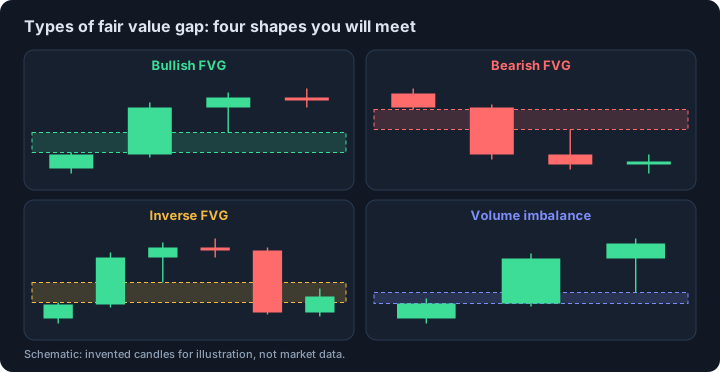
Bullish and bearish FVG
These two are the base types. A bullish gap forms in an up move: the high of candle 1 is below the low of candle 3. A bearish gap forms in a down move: the low of candle 1 is above the high of candle 3. See the full definition on the fair value gap page.
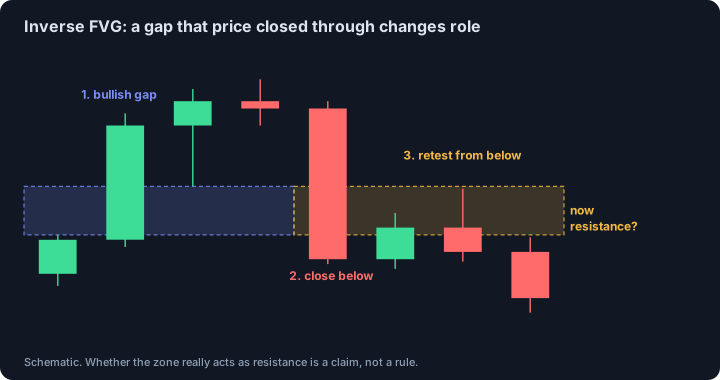
Inverse FVG (IFVG)
An inverse FVG starts as an ordinary gap. If price closes through it, the idea is that the zone changes role: a bullish gap that was closed through is watched as resistance when price comes back from below, and a bearish gap as support. It is the same logic as a support level that turns into resistance after it breaks.
Whether the flipped zone really acts as resistance is a claim. We found no study that tests it, and a gap that was closed through is, by definition, a zone price has already crossed once. Test it on your own data before relying on it.
Volume imbalance
In a volume imbalance the bodies of two neighbouring candles leave a space, but the wicks overlap, so it is not a fair value gap by the strict three-candle rule. The name comes from the idea that the body is where most of the volume traded. Some traders treat it as a weaker cousin of an FVG, others ignore it.
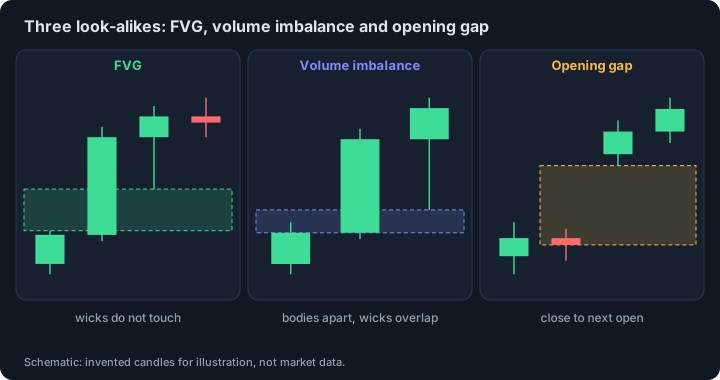
Opening gap and other look-alikes
An opening gap is the space between the close of one session and the open of the next. It exists only in markets that close, such as indices. A fair value gap needs no break in trading. When a gap is large, it also leaves a fair value gap on the candles around it, which is why people mix the two. Names such as balanced price range and consequent encroachment describe overlapping gaps and the midpoint of a gap.
The research on gaps is about session gaps. Practitioner statistics by Bulkowski separate them into area, breakaway, continuation and exhaustion gaps, and show that type changes how long a gap stays open: a median of 3 to 4 days for area gaps against about 89 days for upward breakaway gaps. A peer-reviewed 2025 study of weekend gaps in the DJIA, NASDAQ and DAX found no strong, universal tendency to close gaps at short distances. None of this tests the candle-based FVG types.
Our engine detects the bullish and bearish three-candle gap and tracks its fill state. Inverse gaps, volume imbalances and opening gaps are not separate objects in the engine: an inverse gap is simply a gap in the filled state, and a volume imbalance is not counted because the wicks overlap.
Common mistakes
- Mixing a volume imbalance with a fair value gap: the wicks decide.
- Treating an inverse FVG as a separate signal when it is a role change claim for the same zone.
- Calling a session gap on an index a fair value gap.
This page describes a concept, not a signal. We found no peer-reviewed test of these rules; the independent research we did find is listed under Sources.
Sources and further reading
- Bulkowski, T. Gaps. thepatternsite.com Practitioner statistics on gap types and time to close in a bull market, more than 1,100 gaps. Not peer-reviewed; the period covered is not stated. We read the page.
- Janse van Rensburg, M. and Van Zyl, T. (2025). Price gaps and volatility: do weekend gaps tend to close? Journal of Risk and Financial Management 18(3), 132. Weekend gaps in the DJIA, NASDAQ and DAX, 2013 to 2023. We read the abstract and data description from the university repository.
- OrderBlock.net: what is a fair value gap The three-candle rule, fill states and our statistics in detail.
See also
Educational material about chart concepts. Not financial advice and not a promise of profit.