
What is a market structure shift (MSS)?
A market structure shift (MSS) is a counter-trend break of structure that is forceful: a strong close beyond the last swing against the prevailing trend, usually with large candles (displacement) and often right after a liquidity sweep. Many traders use MSS and change of character (CHoCH) as synonyms; those who separate them reserve MSS for the stronger, displacement version. Neither usage is official.
- Definition: a close beyond the last swing against the trend, with displacement (large candles that leave little overlap), often after a sweep of the trend's extreme.
- MSS vs CHoCH: the same break against the trend. In common usage the words are interchangeable; some traders reserve MSS for the version with displacement after a sweep. Neither usage is official.
- Displacement is a quality filter on the break: a break made of large candles is judged stronger than a slow drift through the level.
- A lone CHoCH or MSS is evidence, not confirmation. Many frameworks wait for a lower high after the break, then a BOS in the new direction, and use a lower timeframe for entry.
- Possible mechanism: a Federal Reserve Bank of New York study found that currency rates trend unusually fast at levels where stop-loss orders cluster, which could produce the large candles that mark displacement. It is a reason to expect fast moves after a stop run, not a test of MSS.
- We found no peer-reviewed test of MSS or of a sweep followed by a structure shift as a trading signal.
Last reviewed: 2026-10-26
What is a market structure shift?
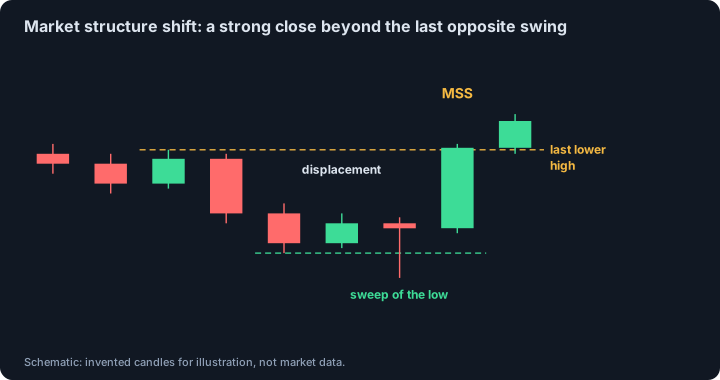
Market structure is the sequence of swing highs and lows. In a downtrend it is lower highs and lower lows; in an uptrend, higher highs and higher lows. A market structure shift is the moment price breaks that sequence against the trend, for example by closing above the last lower high in a downtrend. In the typical picture price makes lower highs and lower lows, then sweeps an obvious low, then a large up candle closes above the last lower high. The chain of lower highs is broken: a bullish MSS. The mirror picture is a bearish MSS.
MSS vs CHoCH vs BOS: how the words relate
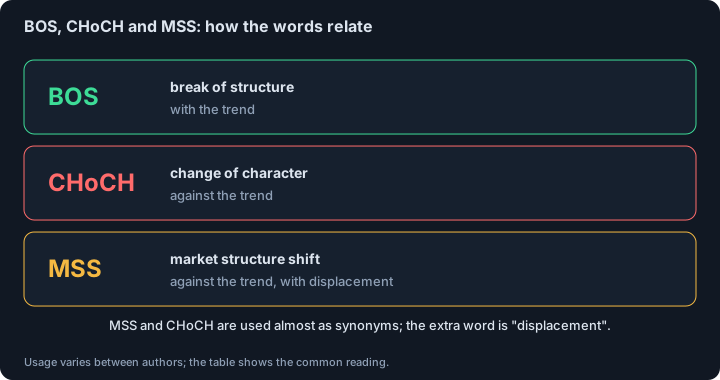
A break of structure (BOS) goes with the trend and signals continuation. A change of character (CHoCH) is the first break against the trend. Many traders use CHoCH and MSS interchangeably. Some reserve MSS for a stronger version: a counter-trend break with displacement right after a liquidity sweep of the trend's extreme. The documentation we read states plainly that neither usage is official. If you read two sources, check that they mean the same thing before comparing setups.
What is displacement?
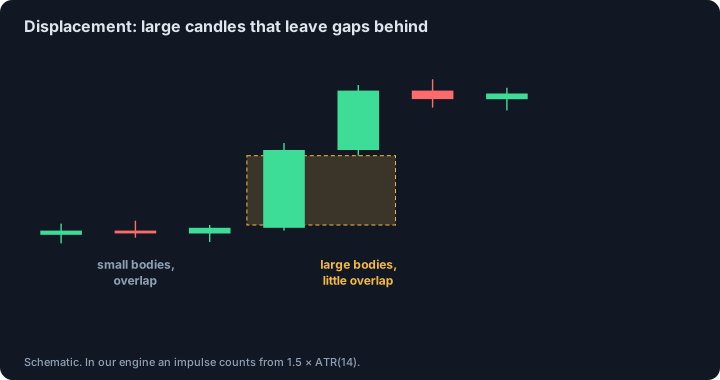
Displacement is a move made of large-bodied candles with little overlap, which often leaves a fair value gap behind. The word is used to separate a real shift from a drift across the level by small candles. It is a quality filter on the break: one documented convention is to judge a break stronger when displacement accompanies it, and a body close beyond the swing, ideally with displacement, is the usual protection against noise and stop runs.
There is no fixed size. In our engine an impulse counts from 1.5 times the average true range (ATR) of 14 bars when we mark order blocks, which is one way to put a number on it. Other tools use other thresholds, so state yours.
MSS after a liquidity sweep: the stricter reading
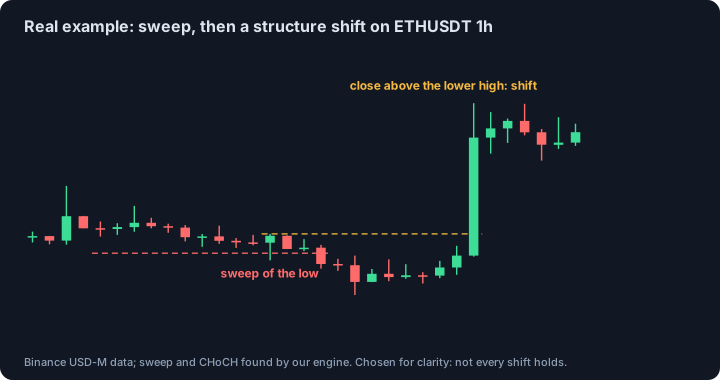
In the stricter reading the shift is preceded by a sweep: price wicks through an obvious low (or high), taking the stops resting there, and then breaks structure the other way. The sequence is sweep, then shift, then a pullback. A sweep is treated as context, and most smart money models wait for a structure shift or displacement before reading it as a reversal. The chart shows a real example on ETHUSDT. The case was chosen because it is easy to read; plenty of sweeps are followed by no shift at all, and plenty of shifts fail.
Bullish MSS and bearish MSS
A bullish MSS breaks a downtrend: after lower highs and lower lows, price closes above the last lower high. A bearish MSS breaks an uptrend: after higher highs and higher lows, price closes below the last higher low. Names follow the direction of the new move, not the direction of the sweep.
Why a stop run might produce a fast move
Carol Osler of the Federal Reserve Bank of New York found that currency rates trend unusually fast when they reach levels at which stop-loss orders have been documented to cluster, that the response to stop-loss orders is larger and lasts longer than the response to take-profit orders, and that most results hold for hours but not for days. A triggered stop-market order is a market order, so a wave of stops adds market orders in the direction of the move. This is a plausible reason for large candles after a stop run. It does not show that a shift after a sweep is a reversal, and it does not test MSS.
How to mark an MSS on a chart, step by step
(1) Fix your swing rule and your break rule (close or wick). (2) Map the trend. (3) Optional, for the strict reading: confirm that a sweep of the trend's extreme came first. (4) Wait for a close beyond the last counter-trend swing, for example above the last lower high. (5) Judge displacement: are the candles large, with little overlap, and did they leave a gap? (6) Mark the swing that was broken, and treat the shift as a warning until your framework's next condition is met.
Common false signals and how frameworks handle them
A lone CHoCH or MSS is evidence, not confirmation, and it fails often: a deep pullback in a healthy trend can break a minor swing and then resume. Many frameworks therefore wait for a lower high after the break, followed by a BOS in the new direction, before treating the reversal as established. Some also look for confirmation on a lower timeframe. Each added condition makes the pattern rarer and easier to find on past charts; the way to know whether it adds anything is to test it.
How to test an MSS rule yourself
Write the rule before you look at results: swing and break rules, whether a sweep is required, how displacement is measured, what you do after the shift. Count every shift the rule finds, including the ones that failed. Include fees. Split the data in time and compare with entries at random times that use the same stop and target. If the rule does not beat random entries, the shift is a description of the chart and not an edge.
We do not count MSS as a separate object. The engine detects a CHoCH, and the impulse size is checked as at least 1.5 × ATR(14) for order blocks. A sweep followed by a reversal CHoCH within 20 bars is tracked as a combined event, which is the closest thing to an MSS in the engine, and the chart above was found that way.
Common mistakes
- Calling a small drift across a level an MSS: there is no displacement.
- Treating MSS as proof of reversal. A lone shift often fails.
- Mixing up MSS with BOS, which continues the trend.
- Requiring a sweep in one analysis and not in the next.
- Comparing setups from sources that define MSS differently.
- Judging displacement by eye instead of writing down a threshold.
This page describes a concept, not a signal. We found no peer-reviewed test of these rules; the independent research we did find is listed under Sources.
Sources and further reading
- LuxAlgo Library: Change of Character (CHoCH). A vendor's documentation: CHoCH and MSS used interchangeably or MSS as the stronger version, with neither usage official; a lone CHoCH often fails. Not an independent study. We read the page.
- LuxAlgo Library: Break of Structure (BOS). Close vs wick conventions and displacement as a judge of a break's quality. Not an independent study. We read the page.
- LuxAlgo Library: Liquidity Sweep. A sweep treated as context; stricter readings require displacement or a change of character on a lower timeframe. Not an independent study. We read the page.
- Osler, C. (2002). Stop-loss orders and price cascades in currency markets. Federal Reserve Bank of New York Staff Report 150. Rates trend unusually fast at levels where stop-loss orders cluster; effects significant for hours, not days. We read the full paper.
- OrderBlock.net: BOS vs CHoCH Swing rules, close vs wick, Dow Theory roots.
- OrderBlock.net: what is a liquidity sweep The sweep that often precedes a shift, with real examples of reversal and continuation.
See also
Educational material about chart concepts. Not financial advice and not a promise of profit.