
ICT vs SMC: what is the difference?
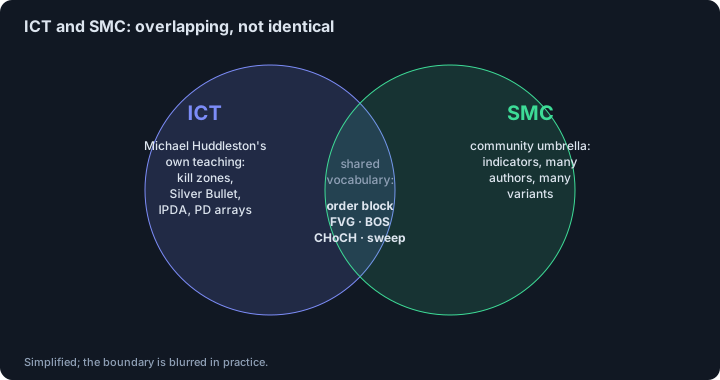
ICT (Inner Circle Trader) is the teaching of Michael Huddleston and the source of terms such as fair value gap, kill zones and the Silver Bullet. SMC (smart money concepts) is a broader community label for analysis built around structure breaks, order blocks, imbalances and liquidity, which borrows much of that vocabulary. They overlap but are not identical. The geometry of the patterns can be checked on a chart; the explanations and the profit claims are a separate matter.
- ICT: the approach taught by Michael J. Huddleston, with its own vocabulary and models (order block, fair value gap, kill zones, premium and discount, optimal trade entry and others). There is no single written rulebook, so teachers explain the same term a little differently.
- SMC: the common name used on indicators, channels and courses for a style of analysis built around structure breaks, order blocks, imbalances and liquidity. It is less tied to one person and more varied.
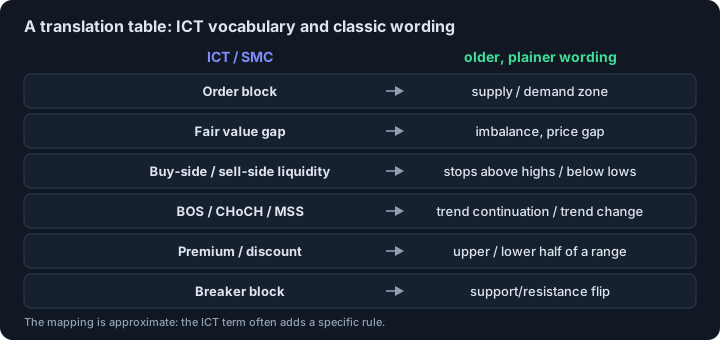
- Most of the vocabulary maps onto older ideas: supply and demand zones, imbalance, stops above highs, support and resistance flips, the 50 percent retracement.
- "Smart money" is not an ICT invention. In academic finance the phrase has a measured meaning: Lu Zheng (Journal of Finance, 1999) studied whether mutual fund investors' money flows are smart and found that funds with net inflows outperformed funds with outflows, but the advantage faded quickly and much of it could be explained by buying recent winners.
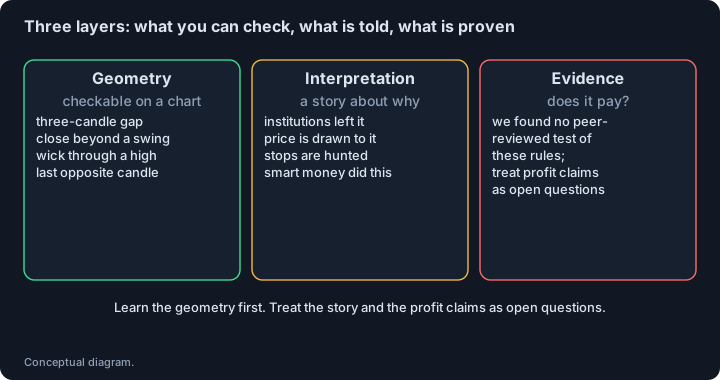
- Checkable: three-candle gaps, a close beyond a swing, a wick through a high. Not checkable on a chart: who left an order, whether price is drawn to a pool of stops.
- We found no peer-reviewed test of ICT or SMC rules.
Last reviewed: 2026-10-26
What is ICT?
ICT stands for Inner Circle Trader, the name used for the approach taught by Michael J. Huddleston in videos, with its own vocabulary and models. Many of the terms were popularised by him: fair value gap, kill zones, the Silver Bullet, premium and discount, optimal trade entry. There is no single written rulebook, so the same term is explained a little differently by different teachers, and the primary source is the author's own material, which we paraphrase and do not copy.
What is SMC (smart money concepts)?
Smart money concepts is the common name used on indicators, channels and courses for a style of analysis built around market structure, order blocks, imbalances and liquidity. It borrows much of ICT's vocabulary and is less tied to one person, so it is more varied: different authors and indicator vendors define the same word with different rules. When a source says SMC, ask which definition it uses.
ICT vs SMC: how they overlap
They share most of the working vocabulary: order block, fair value gap, break of structure, change of character and liquidity sweep. ICT adds its own models and time frameworks, such as kill zones, the Silver Bullet and the premium and discount grading of entries. SMC is the broader label under which many of the same words are used on indicators. In practice the boundary is blurred, and a vendor's documentation often labels a concept as Smart Money Concepts and ICT in one breath.
Where does the term "smart money" come from?
The phrase is far older than ICT. In academic finance it has a measured meaning. Lu Zheng's 1999 paper in the Journal of Finance asked whether the money of mutual fund investors is smart, meaning whether the funds that attract net inflows do better than those that lose money. Using a large sample of equity funds, the author found that funds attracting inflows tended to outperform funds losing money, but the advantage faded quickly, much of it could be explained by buying recent winners, and in aggregate the inflow funds did not significantly beat the market. Later studies have found mixed results.
Trader slang uses the phrase differently, for the supposed footprints of large informed players on a chart. The Composite Man associated with the name Wyckoff comes from his later courses and from followers; in our Rulebook we did not find it stated in the book text we read. So the idea that large players leave readable footprints is old, but it is a trading narrative, not the academic finding.
The terms, translated into older wording
Most of the vocabulary maps onto older ideas. An order block is a narrow supply or demand zone tied to one candle and one impulse. A fair value gap is an imbalance or price gap defined by three candles. Buy-side liquidity is a cluster of stops above highs and sell-side liquidity below lows. Premium and discount are the two halves of a range, and the 50 percent split is much older than ICT. A breaker is a support or resistance level that flipped. A break of structure and a change of character are trend continuation and a first sign of a trend change. The new term usually adds a specific rule.
What you can check, what is told, and what is proven
Separate three layers. The geometry is checkable on a chart: three candles with non-overlapping wicks, a close beyond a swing, a wick through a high. The interpretation, that institutions left this, that price is drawn to it, that stops are hunted, cannot be seen on a candlestick chart; the closest hard evidence is research on real orders, which shows that stop and take-profit orders cluster at obvious prices, not that anyone moves price to them. And whether it makes money is a separate question that has to be tested with rules written in advance, with fees, and on data the rules did not see.
We found no peer-reviewed test of ICT or SMC rules. The independent research we did find supports parts of the mechanism, and each page of this section lists it. Learn the geometry, and treat the story and the profit claims as open questions.
Where to start: a reading order
Start with market structure (BOS and CHoCH, then market structure shift), because everything else is read against it. Then liquidity and the liquidity sweep, then the zones: order block, fair value gap and its types, breaker block. Then the location tools: premium and discount and optimal trade entry. Finally the time frameworks: kill zones. On each page, check the definition, the real chart and the sources, and decide which convention you will use before you apply it.
OrderBlock.net uses open-source engines with written definitions of swings, BOS, CHoCH, order blocks, fair value gaps, equal highs and lows, and sweeps. The definitions are listed on the pages of each term and are applied without look-ahead.
Common mistakes
- Treating one teacher's definition as the standard.
- Confusing a good-looking explanation with evidence.
- Calling any chart pattern "smart money" without a stated rule.
- Learning every term before checking the basic geometry on your own charts.
- Comparing setups from sources that use the same word with different rules.
This page describes a concept, not a signal. We found no peer-reviewed test of these rules; the independent research we did find is listed under Sources.
Sources and further reading
- Zheng, L. (1999). Is money smart? A study of mutual fund investors' fund selection ability. Journal of Finance 54(3), 901-933. Funds with net inflows outperformed funds with outflows, but the advantage faded quickly and much of it was explained by buying recent winners. We read the abstract page.
- LuxAlgo Library: Premium & Discount. A vendor's documentation: attributes the vocabulary to Michael J. Huddleston (ICT) and earlier roots of the 50 percent level to W. D. Gann and floor traders. Not an independent study. We read the page.
- OrderBlock.net Rulebook: Richard Wyckoff What the Wyckoff book text we read does and does not state about the Composite Man.
- OrderBlock.net: BOS vs CHoCH The structure vocabulary and its swing rules.
- OrderBlock.net: what is liquidity in ICT and smart money The research on order clustering behind the liquidity idea.
See also
Educational material about chart concepts. Not financial advice and not a promise of profit.