
- The pattern has a name, the disposition effect: the tendency to sell winning investments too soon and hold losing ones too long (Shefrin and Statman, 1985).
- Odean (Journal of Finance, 1998) analysed 10,000 brokerage accounts: 14.8% of paper gains were realised against 9.8% of paper losses, computed from the counts in his Table I.
- It did not pay. In his sample, winners that were sold outperformed the losers that were kept by 3.4 percentage points over the following year; that sample is US stocks in 1987–1993, not crypto.
- The fix is not willpower but rules made before entry: a stop that only moves in the direction of risk reduction, a written exit for winners, and a log that compares how long you hold winners and losers.
Short answer. Because closing a loss feels worse than holding it, and closing a win feels better than holding it. Behavioural finance calls this the disposition effect, it shows up in large datasets of ordinary investors, and in the best-known study the habit did not earn anything: the winners that were sold did better afterwards than the losers that were kept.
What is the disposition effect?
Terrance Odean opens his paper with the definition and credits the term:
The tendency to hold losers too long and sell winners too soon has been labeled the disposition effect by Shefrin and Statman (1985).
Odean, Journal of Finance (1998)
Shefrin and Statman’s article is titled “The Disposition to Sell Winners Too Early and Ride Losers Too Long: Theory and Evidence” (Journal of Finance, 1985).1 It places the pattern inside the broader idea that people dislike realising a loss. The point of the term is that the behaviour is systematic, not random: it leans the same way for many people.
What do the numbers show?
Odean obtained trading records for 10,000 accounts at a large discount brokerage from 1987 through 1993. He counted, each day an account sold something, how many of its positions were up (paper gains) and down (paper losses), and which ones were sold. From the counts in his Table I (13,883 realised gains and 79,658 paper gains; 11,930 realised losses and 110,348 paper losses) the proportion of gains realised is 14.8% and the proportion of losses realised is 9.8%.2
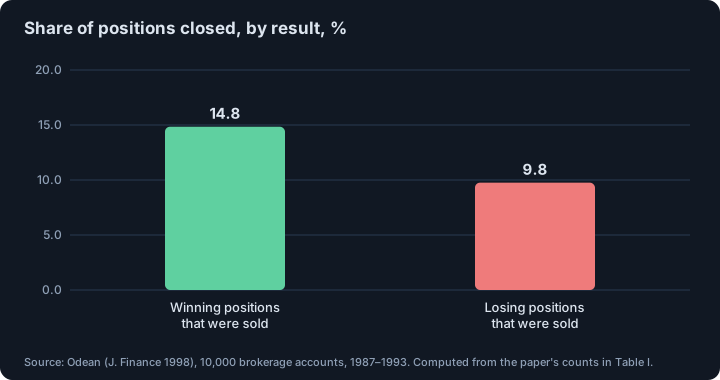
In plain words: when a position was up, it was sold about 1.5 times as often as when it was down. Odean’s abstract states the finding directly:
These investors demonstrate a strong preference for realizing winners rather than losers.
Odean, Journal of Finance (1998), abstract
He checked the obvious innocent explanations. The behaviour was not explained by rebalancing portfolios, or by the higher trading costs of low-priced stocks, and it was not “justified by subsequent portfolio performance”.2
Does holding losers pay off?
In that sample, no. Odean compared what happened after the sale: for winners that were sold, the average excess return over the following year was 3.4 percentage points higher than for losers that were not sold.2 Investors who held on because they expected losers to catch up were, on average, mistaken.
Keep the limits in view. The data are US stocks in 1987–1993 from one broker, not leveraged crypto. Odean’s own subject is realisation of paper gains and losses, not stop-loss placement, so the step to “moving your stop” below is our reading of the same psychology, not something his data measure. And a leveraged position that is held while losing can end in liquidation, which stocks bought outright cannot: see how liquidation works.
What does it look like in a trade log?
Three signs you can check in your own journal:
- Winners are held shorter than losers. Compare the median holding time of your winning and losing trades.
- Average win is smaller than average loss, even though the plan said 2:1.
- Stops get moved. The planned stop was 1R; the trade was closed at −2R or −3R.
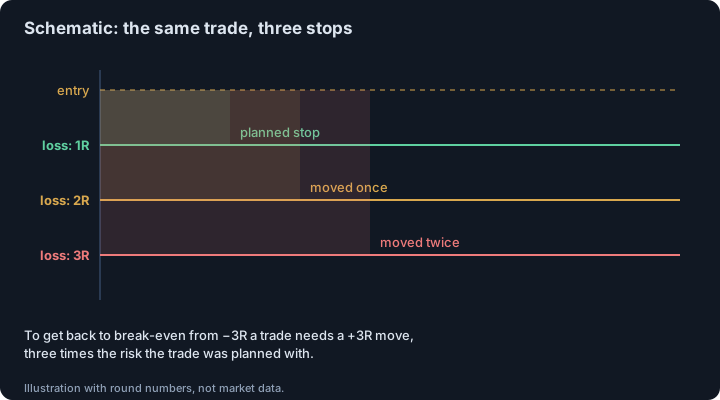
The arithmetic is cruel. To recover from −3R, the trade needs a +3R move: three times the risk it was planned with. For how a loss pushes people into doubling down, see revenge trading after a loss.
How do I stop cutting winners and holding losers?
The research does not offer a cure, but it supports the shape of one: decide before the position is open, because the reluctance appears after it is open.
- Write the stop before entry and allow it to move in one direction only, towards less risk. If the idea is wrong, you close; you do not give it more room.
- Write the exit for a winner as a rule: a target, a trailing rule or a partial-exit schedule. Do not decide it by how nervous you feel.
- Turn it into an if-then sentence, such as “if price hits the stop, I close at market and log it”. Gollwitzer and Sheeran’s meta-analysis found that such implementation intentions help people reach goals (94 tests, effect size d = .65): see if-then trading rules.
- Log hold time and result in R for every trade, and review the median hold time of winners versus losers monthly.
- Reduce the pull. Smaller size makes a loss easier to take; the risk simulator shows how often a given size will put you through a run of losses, and the session plan lets you set limits in advance.
None of this is a promise of profit. A rule only removes one known way to lose, and the strategy still needs a real edge: how many trades prove a strategy works.
This is educational material, not investment advice.
Footnotes
-
Shefrin, H., Statman, M., “The Disposition to Sell Winners Too Early and Ride Losers Too Long: Theory and Evidence”, Journal of Finance 40(3), July 1985, pp. 777–790. We read the bibliographic record, part of the abstract and Odean’s citation of it; we did not read the full article. ↩
-
Odean, T., “Are Investors Reluctant to Realize Their Losses?”, Journal of Finance 53(5), October 1998, pp. 1775–1798 (full text read). Data: 10,000 randomly selected accounts at a large discount brokerage, trades 1987–1993. Counts and the 3.4 percentage point figure are from the paper’s Table I and its section on subsequent returns; the 14.8% and 9.8% ratios are our computation from those counts. ↩ ↩2 ↩3
Frequently asked questions
What is the disposition effect in trading?
It is the tendency to sell winning positions too soon and hold losing positions too long. The term was introduced by Shefrin and Statman in 1985 and measured by Odean in 1998 on 10,000 brokerage accounts.
Why do I cut my winners early?
Realising a gain feels good and removes the risk of seeing it vanish. In a large brokerage sample, 14.8% of paper gains were sold against 9.8% of paper losses, so the habit is common rather than personal.
Why do I hold losing trades instead of closing them?
Closing a loss makes it real, so many people wait for the price to come back. In Odean’s data the losers that investors kept did not outperform the winners they sold.
How do I stop moving my stop loss?
Decide the stop before entry and allow it to move only to reduce risk, never to widen it. If the idea is wrong, close the trade; do not give it more room.
Sources
- Are Investors Reluctant to Realize Their Losses?. Terrance Odean. The Journal of Finance 53(5), 1775–1798, October 1998, 1998
- The Disposition to Sell Winners Too Early and Ride Losers Too Long: Theory and Evidence. Hersh Shefrin, Meir Statman. The Journal of Finance 40(3), 777–790, July 1985, 1985
- Implementation Intentions and Goal Achievement: A Meta-analysis of Effects and Processes. Peter M. Gollwitzer, Paschal Sheeran. Advances in Experimental Social Psychology 38, 69–119, 2006
This article is research, not investment advice. Results on history do not guarantee future results.