
- Short answer: Lo and Repin measured skin conductance, pulse, heart rate, muscle signals, respiration and temperature of 10 professional traders during live trading and found significant correlations between skin responses and transient market events, and between cardiovascular changes and market volatility.
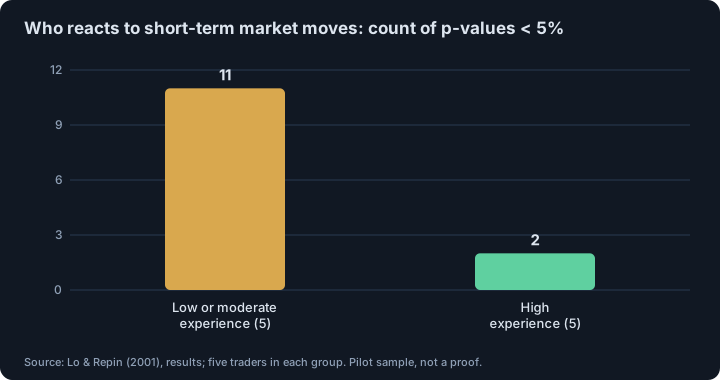
- Experience seemed to matter: sessions with five low or moderate experience traders produced 11 significant correlations (p below 5%) with short-term market events, sessions with five highly experienced traders only 2. The authors suggest less experienced traders may be more sensitive to short-term changes.
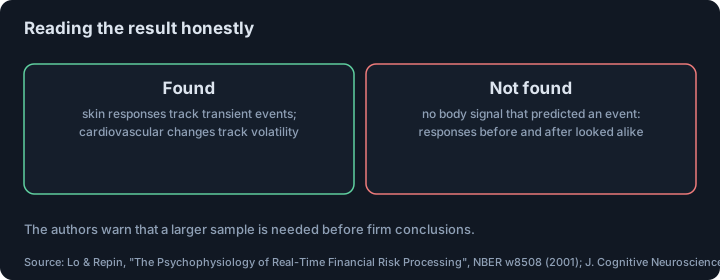
- They did not find that a body signal anticipated a market event: responses in the 10 seconds before and after events looked alike. And the sample is a pilot of 10 traders at one desk; the authors say more work is needed before firm conclusions.
- The paper’s claim is modest and useful: emotion and decision-making are not opposites, and trained traders respond physically to markets. It gives no evidence that a body signal improves trading.
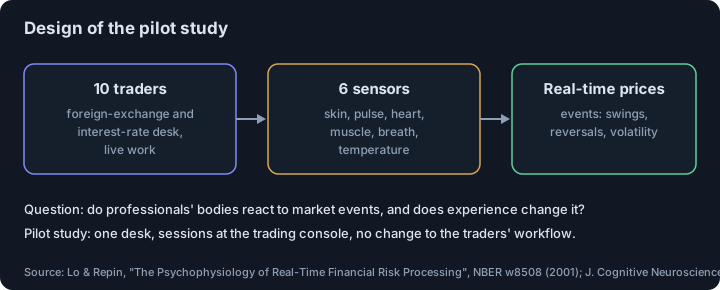
Short answer. Do professional traders feel the market in their bodies? In 2001 Andrew Lo and Dmitry Repin attached portable sensors to 10 traders of a foreign-exchange and interest-rate desk and recorded their skin, pulse and breathing during live work, together with real-time prices. They found that skin responses followed brief market events and cardiovascular changes followed volatility, and the pattern differed with experience. They did not find a body signal that predicted the market.1
What question did the study ask?
The authors start from an old controversy: are markets driven by rational forces or by emotional responses? Efficient-market advocates see prices that fully reflect information; critics point to overconfidence, loss aversion, herding and regret. The authors suggest that recent cognitive research implies rationality and emotion are not antithetical but complementary, and they test the link on people for whom both matter, professional traders in their natural environment.1
How was it measured?
The 10 subjects worked at the foreign-exchange and interest-rate derivatives business unit of a major global financial institution in Boston, a unit of about 90 professionals that executes 1,000 to 1,200 trades a day at an average of USD 3 to 5 million, about 80% for clients. Using portable biofeedback equipment, six sensors recorded skin conductance, blood volume pulse, heart rate, muscle signals, respiration and temperature, without disrupting the traders’ workflow, while real-time prices were captured to define market events: deviations from a mean, trend reversals and volatility events.1
What did the bodies respond to?
In the sample of 10 traders the authors found significant correlation between electrodermal responses (skin conductance) and transient market events, and between changes in cardiovascular variables and market volatility. Volatility events, defined over five-minute windows, were highly correlated with the amplitude of the blood volume pulse across the three kinds of volatility measures used.1
Did experience matter?
The authors split the traders into two groups of five, highly experienced and low-to-moderate experience. Sessions with the less experienced traders yielded 11 p-values below 5% in correlations between short-term events (deviations and trend reversals) and physiological responses, against only 2 for the sessions with the highly experienced traders. They read this as a sign that less experienced traders may be more sensitive to short-term changes in market variables than more experienced colleagues; for volatility events the pattern was similar in both groups.1
Could the body predict the move?
No. The authors compared 10-second windows before and after each event with control periods to test for anticipatory responses. The two sets of tests gave very similar results, implying that none of the physiological variables predicted anticipatory emotional responses. They suggest this may partly be because of how the events were defined: with events defined as deviations from an average, the traders may be reacting to conditions throughout the period, not at the exact moment.1
What are the limits?
It is a pilot with 10 traders at one desk, working on mostly foreign-exchange instruments. Splitting 10 into two groups of five and counting p-values is a hint, not a proof. The authors themselves say more work is needed before firm conclusions about the precise mechanisms. The paper also does not test whether the physical response helps or hurts performance.1
What a trader can take from this
- Feeling something is normal. Professionals show physical responses to price events. The paper does not treat that as a flaw.
- Experience may calm the short-term noise. The experienced group reacted less to short-term moves, a hint that practice changes the response, not that a calm body is a good signal.
- Do not trust gut feelings as predictions. In this study nothing in the body anticipated the market. What happens to risk-taking under stress hormones is in what cortisol does to risk taking.
- Build rules around the response. If-then plans for the moments you know will be tense are in if-then trading rules; what the pull to win it back after a loss does is in revenge trading, and why streaks feel like signals in the gambler’s fallacy in trading.
- Fewer, calmer decisions. The cost of reacting to every short-term move is in overtrading.
This is educational material, not investment advice or a medical statement.
Footnotes
-
Lo, A. W., Repin, D. V., “The Psychophysiology of Real-Time Financial Risk Processing”, NBER Working Paper 8508, October 2001 (full text of the PDF read); the Journal of Cognitive Neuroscience citation (14(2), 2002, pp. 323–339) is from the author’s page listing. Abstract and introduction: the question, the controversy, the pilot sample of 10 traders, the correlations found, the link to experience. Results section: the subjects and the desk (about 90 professionals, 1,000 to 1,200 trades a day, USD 3 to 5 million average, 80% for clients), six sensors, events defined as deviations, trend reversals and volatility (five-minute windows), the split into two groups of five (11 against 2 p-values below 5%), the pre- and post-event comparison with control intervals, and the authors’ caution about firm conclusions. ↩ ↩2 ↩3 ↩4 ↩5 ↩6 ↩7
Frequently asked questions
Do professional traders really react emotionally to the market?
In the Lo and Repin pilot study of 10 professional traders, yes in a physiological sense: skin conductance responses correlated significantly with transient market events such as price deviations and trend reversals, and changes in cardiovascular variables correlated with market volatility. The authors interpret this as evidence that emotion plays a role in professional traders’ decision-making.
Does experience reduce emotional reactions to the market?
The paper suggests so, with caution. Sessions with five low or moderate experience traders produced 11 p-values below 5% in correlations with short-term events, against two for sessions with five highly experienced traders. The authors say the differences may be systematically related to experience; the groups are very small.
Can body signals predict market events or good trades?
The study did not find that. Comparing the 10 seconds before and after events with control periods, the authors found similar results, implying that none of the physiological variables predicted anticipatory emotional responses. They also note this may be partly due to how events were defined.
How was the study run?
Ten professional traders at the foreign-exchange and interest-rate derivatives unit of a major global financial institution in Boston wore portable sensors while trading at their own consoles. Real-time prices were captured at the same time and used to define events such as deviations, trend reversals and volatility. The unit executed about 1,000 to 1,200 trades a day at an average size of USD 3 to 5 million.
Does this mean I should trade by feel?
No. The paper shows that traders respond physically to market events, not that those responses improve decisions. Its authors present emotion as part of decision-making, which is a reason to build rules and checks around it, not to rely on it.
Sources
- The Psychophysiology of Real-Time Financial Risk Processing. Andrew W. Lo, Dmitry V. Repin. NBER Working Paper 8508, October 2001 (full text read); published in the Journal of Cognitive Neuroscience 14(2), 2002, pp. 323–339, 2001
This article is research, not investment advice. Results on history do not guarantee future results.