
- Short answer: partly structure, partly statistics. Stop-loss orders really do cluster just beyond round numbers (Osler, 9,667 orders at a dealing bank), and a tight stop is hit by plain noise most of the time.
- In our simulation of a coin-flip price (no one hunting anything), a stop set 0.5 standard deviations of the session’s move away was hit in 58% of sessions, and in 42% of those cases price later came back to your entry.
- The data are foreign-exchange orders from 1999–2000. They show clustering, not that anyone targets your stop; we found no study that proves stop hunting in crypto.
- What to do: place the stop where the trade idea is wrong, not at a round number, and size the position to the stop, not the stop to the position.
Short answer. There are two causes, and traders mix them up. One is structural: stop-loss orders from many people sit at similar prices, so reaching those prices can trigger fast moves. The other is statistical: a stop that is close to the entry is hit by ordinary noise in most sessions, and after any hit, price has close to a coin-flip chance of drifting back. You usually cannot tell which one hit you, but you can reduce both.
Do stop-loss orders really cluster around round numbers?
Yes, in the one dataset we found that records them. Carol Osler of the Federal Reserve Bank of New York examined about 9,700 stop-loss and take-profit orders placed at a large foreign-exchange dealing bank between September 1999 and April 2000.1 Her central finding, in her own words:
Take-profit orders tend to reflect price trends, and stop-loss orders tend to intensify trends.
Osler, NY Fed Staff Report 125 (2001), abstract
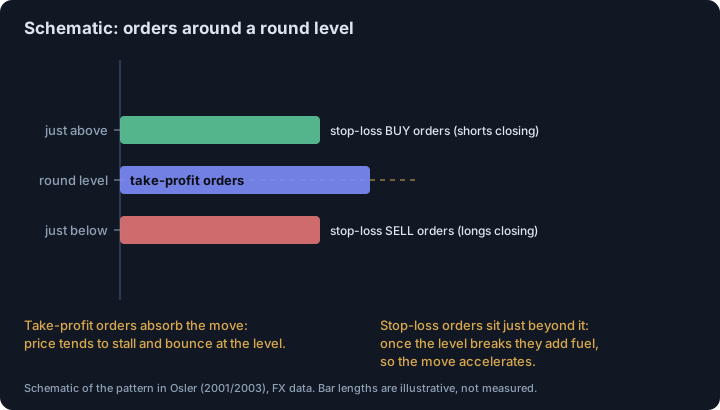
The orders did not sit at random prices. Osler reports that the requested execution rates are “strongly clustered at round numbers”, and that the two order types cluster differently: stop-loss buy orders tend to sit just above a round number (her example is 1.6605 rather than 1.6600), stop-loss sell orders just below.1
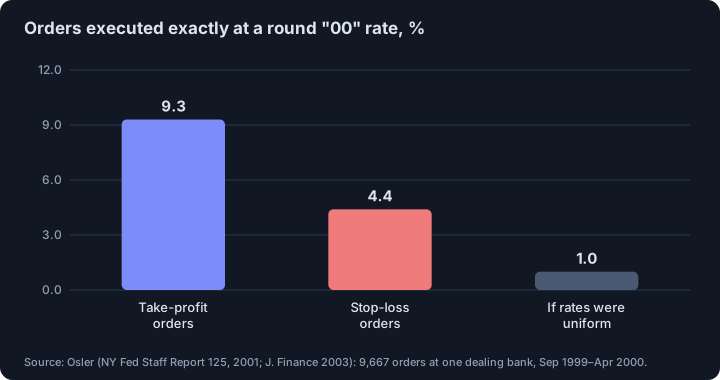
The numbers show the difference between the two order types. Among executed orders, 9.3% of take-profit orders were at a rate ending exactly in “00”, against 4.4% of stop-loss orders. If rates were spread evenly, each ending would get about 1%.1
What does that mean for your stop?
Osler’s mechanism has two halves. Take-profit orders sit at the round number and absorb the move, so price tends to stall there. Stop-loss orders sit just beyond it, so once the level breaks, they feed the move.1 A trader whose stop is set a few ticks past an obvious round level is standing in the queue with many others.
Two cautions keep this honest. First, Osler herself notes that it is not possible to prove her bank’s orders are representative of all orders in the market, though she sees no reason to think they are not.1 Second, the data describe currency orders in 1999–2000. We did not find a published study that measures the same thing for crypto perpetuals, so applying it there is an inference. In leveraged markets the forced orders are liquidations, and the BIS wrote in March 2026 that the large crypto sell-offs were “probably exacerbated by liquidations of leveraged long crypto positions”.2 That is a statement about forced selling in general, not about where your particular stop is.
Why does price come back to my entry after a tight stop?
Even with nobody targeting you. We simulated 100,000 random price paths with no trend and no information (our own simulation, 100 steps per session, price move scaled so one session has a standard deviation of 1) and put a long stop below the entry:
| Stop distance (× session σ) | Stop is hit | Of hits: price later returns to entry | Of hits: session ends above the stop level |
|---|---|---|---|
| 0.5 | 58% | 42% | 47% |
| 1.0 | 29% | 10% | 45% |
| 1.5 | 12% | 1% | 44% |
Read the first row as a trader would. A stop half a standard deviation from entry is hit in most sessions, and then price climbs back to your entry about four times in ten. Nothing hunted you: that is what noise does. The last column is near 50%: after a hit, price is about as likely to be higher by the end as lower, which is exactly why it “always” seems to reverse. You remember the times it did, not the times it kept falling.
How to place a stop so it survives noise
- Put it where the idea is wrong. The stop belongs at the price that invalidates the trade, which is usually beyond a swing high or low, not at a fixed number of points.
- Avoid the exact round number and the tick just beyond it. If your analysis says the level is 60,000, the invalidation is not 59,990.
- Measure the noise. Compare the stop distance with the typical range of your timeframe. If the stop is inside it, expect to be hit often.
- Pay for width with size, not with hope. A wider stop costs more per hit, so cut the position so the loss in R stays the planned amount. See position sizing with the Kelly criterion and futures liquidation explained.
- Count slippage. Stops fill at market, often worse than the stop price: slippage and price impact.
You can see where large resting orders and recent liquidations sit on our liquidations page and in the order-book view of Crypto Radar. Treat them as context: resting orders can be pulled at any moment (see what spoofing is).
Related. What Caused the 2010 Flash Crash: Liquidity Vanished.
This is educational material, not investment advice.
Footnotes
-
Osler, C. L., “Currency Orders and Exchange-Rate Dynamics: Explaining the Success of Technical Analysis”, Federal Reserve Bank of New York Staff Report 125, March 2001 (full text read). Data: 9,667 conditional orders at a large dealing bank, 1 September 1999 – 11 April 2000, dollar-yen, dollar-pound and euro-dollar. Quotations and the 9.3% / 4.4% / 1% figures are from the working paper; the published version is Journal of Finance 58(5), 2003, pp. 1791–1820, which we did not read in full, so details may differ. ↩ ↩2 ↩3 ↩4 ↩5
-
BIS Quarterly Review, March 2026, overview page, section on markets (published 16 March 2026). The quoted sentence is from the overview; we did not read the full report. ↩
Frequently asked questions
Is a stop hunt real?
Stop-loss orders do cluster at predictable prices, which makes those prices attractive for fast price moves. Published evidence (Osler) shows the clustering in currency orders; it does not show that a specific party targets a specific retail stop.
Why does price go to my stop and then reverse?
Because a tight stop sits inside normal price noise. In a simulated random price, a stop 0.5 standard deviations of the session move away is hit in about 58% of sessions, and price ends above the stop level in about 47% of those.
Where should I put my stop to avoid being stopped out by noise?
At the price where your trade idea is proved wrong, beyond the recent noise range, and not right at a round number. Then size the position so that this stop costs the risk you planned.
Does a wider stop make a trade safer?
A wider stop is hit less often but costs more each time, so it only helps if position size is reduced to keep the loss per trade the same.
Sources
- Currency Orders and Exchange-Rate Dynamics: Explaining the Success of Technical Analysis. Carol L. Osler. Federal Reserve Bank of New York Staff Report 125, March 2001 (published as “Currency Orders and Exchange Rate Dynamics: An Explanation for the Predictive Success of Technical Analysis”, Journal of Finance 58(5), 1791–1820, 2003), 2001
- BIS Quarterly Review, March 2026: Markets recalibrate amid shifting currents (overview). Bank for International Settlements, 16 March 2026, 2026
This article is research, not investment advice. Results on history do not guarantee future results.