
- Short answer: a leveraged ETF resets its leverage every day, so after a rise it holds more and after a fall it holds less. In a choppy market that means buying high and selling low, and the fund loses even if the index ends where it began.
- The exact formula (Avellaneda and Zhang, 2010): the fund’s value equals the index multiple raised to the power β, times exp(−(β²−β)/2 × realized variance), before fees and funding. For 2x the variance term is −1 times variance, for 3x it is −3 times.
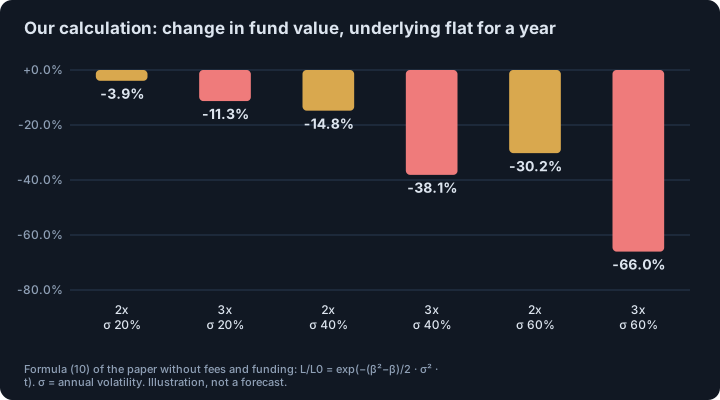
- Our calculation from that formula: with the price flat for a year, a 3x fund loses about 11% at 20% volatility, 38% at 40% and 66% at 60%. Bitcoin’s annualized volatility in our data is 61%.
- The authors tested 56 funds over 2008–2009 and found the formula accurate; they conclude the funds “may be unsuitable for buy-and-hold investors”. The period was extreme, and the formula does not apply to a plain futures position that is not reset daily.
Short answer. A leveraged ETF promises a multiple of the index’s daily return, not of its return over a month or a year. To keep that promise it has to rebalance every day: more exposure after a rise, less after a fall. Avellaneda and Zhang proved that this makes the holder short realized variance: the more the index zigzags, the more the fund loses against a fixed leveraged position, with no crash needed.1
Why does a 3x ETF lose money when the index goes nowhere?
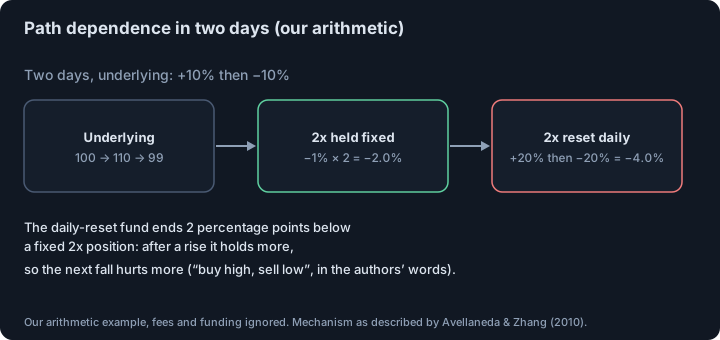
A fund with leverage β holds β dollars of exposure per dollar of its own value. When the index rises, the fund’s value rises faster than its exposure, so exposure per dollar of value falls below β and the manager must buy to restore it. When the index falls, the opposite. In the authors’ words, the manager “must necessarily” buy high and sell low to hold the target leverage.1
Two days make it concrete. The index rises 10% then falls 10%, ending at 99, down 1%. A fixed 2x position ends at −2%. A daily-reset 2x fund gains 20%, then loses 20% of the larger amount: 100 → 120 → 96, down 4%.
What is the exact formula for volatility decay?
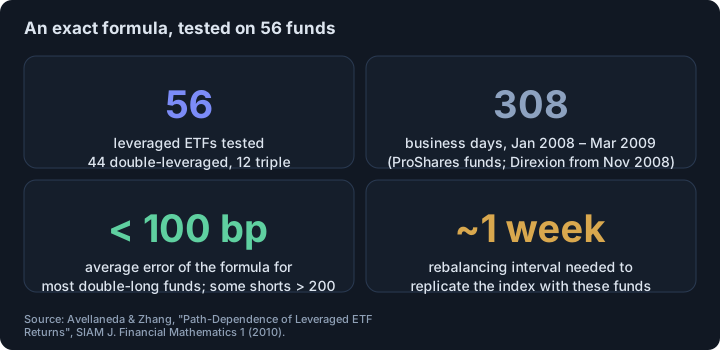
For a fund with leverage β, in the idealized case where the index follows a continuous process and the fund rebalances continuously, the paper’s formula (10) is:1
fund value ÷ start value = (index ÷ start index)^β × exp( ((1−β)·r − f)·t + ((β − β²)/2) × ∫σ² dt )
Here r is the funding rate, f the expense ratio and the integral is the realized variance over the period. The last term is the decay. For β = 2 it is −1 × variance, for β = 3 it is −3 × variance, for β = −2 it is −3 × variance.1 The sign does not depend on direction: whether the fund is long or short the index, the holder is short volatility. For short funds there is also a borrowing-cost term.
How accurate is it?
The authors tested the formula on 56 funds: 44 double-leveraged ProShares funds (22 long and 22 short) from 2 January 2008 to 20 March 2009 (308 business days), and 12 triple-leveraged Direxion funds listed from November 2008.1 They report “excellent agreement”, with average errors mostly below 100 basis points for the long funds and a few short funds above 200.1 They also found that over 60-day windows most of these funds trailed the matching static leveraged portfolio, and that they beat it only when returns were large and volatility was small.1
How big is the loss at 20%, 40% and 60% volatility?
Take the formula without fees or funding and let the index end the year exactly where it started. The fund’s value then equals exp(−(β²−β)/2 × σ²). This is our calculation, an illustration and not a forecast:2
| Annual volatility | 2x fund after a flat year | 3x fund after a flat year |
|---|---|---|
| 20% | −3.9% | −11.3% |
| 40% | −14.8% | −38.1% |
| 60% | −30.2% | −66.0% |
For scale, in our Binance BTCUSDT daily data (September 2019 to October 2026) annualized volatility is 61%, which would put a 3x daily-reset product near −68% after a flat year under the same formula.2 These numbers are before fees and funding, which make things worse, and real years are not flat: a strong, smooth trend lifts a leveraged fund above its multiple, which is the other side of the same formula.
Does the same decay hit leveraged futures positions?
Not by itself. The formula describes a position that is reset to constant leverage every day. A plain perpetual-futures position with a fixed number of contracts is not reset: its leverage drifts with profit and loss, and its main danger is liquidation, not decay. The decay does appear if you reset on purpose, for example by adding margin after a loss and trimming after a gain to hold 3x, or if you hold a product that does it for you. Funding is a separate cost: see how perpetual funding works.
What should a trader take from this?
- A multiple of the daily return is not a multiple of the long-term return. Over weeks and months the path matters, because the product is built around a daily exposure target (section 2 of the paper).
- The cost scales with variance, so the same fund is harmless in a calm trend and costly in a choppy range. Check realized volatility before holding longer than a day.
- Bigger leverage hurts faster than linearly: going from 2x to 3x triples the decay term, not 1.5×.
- Sizing logic points the same way: see position sizing and the Kelly criterion.
This is educational material, not investment advice.
Related. Futures liquidation: how it works, perpetual futures funding.
Footnotes
-
Marco Avellaneda and Stanley Zhang, “Path-Dependence of Leveraged ETF Returns”, SIAM Journal on Financial Mathematics 1 (2010), 586–603 (author copy read in full: abstract, sections 1–3, formulas (1)–(10), Tables 1–4). The 2008–2009 sample contains the financial crisis; the formula is exact for an Ito process with continuous rebalancing and approximate for daily data. Quotes: abstract (“may be unsuitable for buy-and-hold investors”) and section 1 (“buy high and sell low”). ↩ ↩2 ↩3 ↩4 ↩5 ↩6 ↩7
-
Our calculation. The table and the −68% figure apply formula (10) with fees, funding and borrowing costs set to zero and the index ending flat. Volatility of 61% is the standard deviation of daily log returns of Binance USD-M BTCUSDT daily closes (2,583 days, 9 September 2019 to 4 October 2026) multiplied by √365. ↩ ↩2
Frequently asked questions
Why do leveraged ETFs lose money in a sideways market?
They rebalance to the target leverage every day. After a rise they must add exposure and after a fall they must cut it, which means buying high and selling low. The cost grows with realized variance, so a choppy market that ends flat still produces a loss.
What is volatility decay in a leveraged ETF?
It is the part of the return that depends on realized variance rather than on the direction of the index. Avellaneda and Zhang show it enters the exponent as (β−β²)/2 times variance: −1 for a 2x fund, −3 for a 3x fund and −3 for a −2x fund.
Is a 3x leveraged ETF the same as holding 3x leverage for a year?
No. A fixed 3x position and a daily-reset 3x fund diverge over any period longer than a day, and the gap grows with volatility. The two only coincide when the index moves in a steady line.
Does volatility decay apply to leveraged crypto futures?
Not to a plain futures position with a fixed number of contracts, which is not reset daily. It does apply to products that reset leverage daily, and to a trader who tops up or trims margin to keep leverage constant.
Sources
- Path-Dependence of Leveraged ETF Returns. Marco Avellaneda and Stanley Zhang, SIAM Journal on Financial Mathematics 1, 586–603 (DOI 10.1137/090760805); NYU author copy read in full, 2010
This article is research, not investment advice. Results on history do not guarantee future results.